
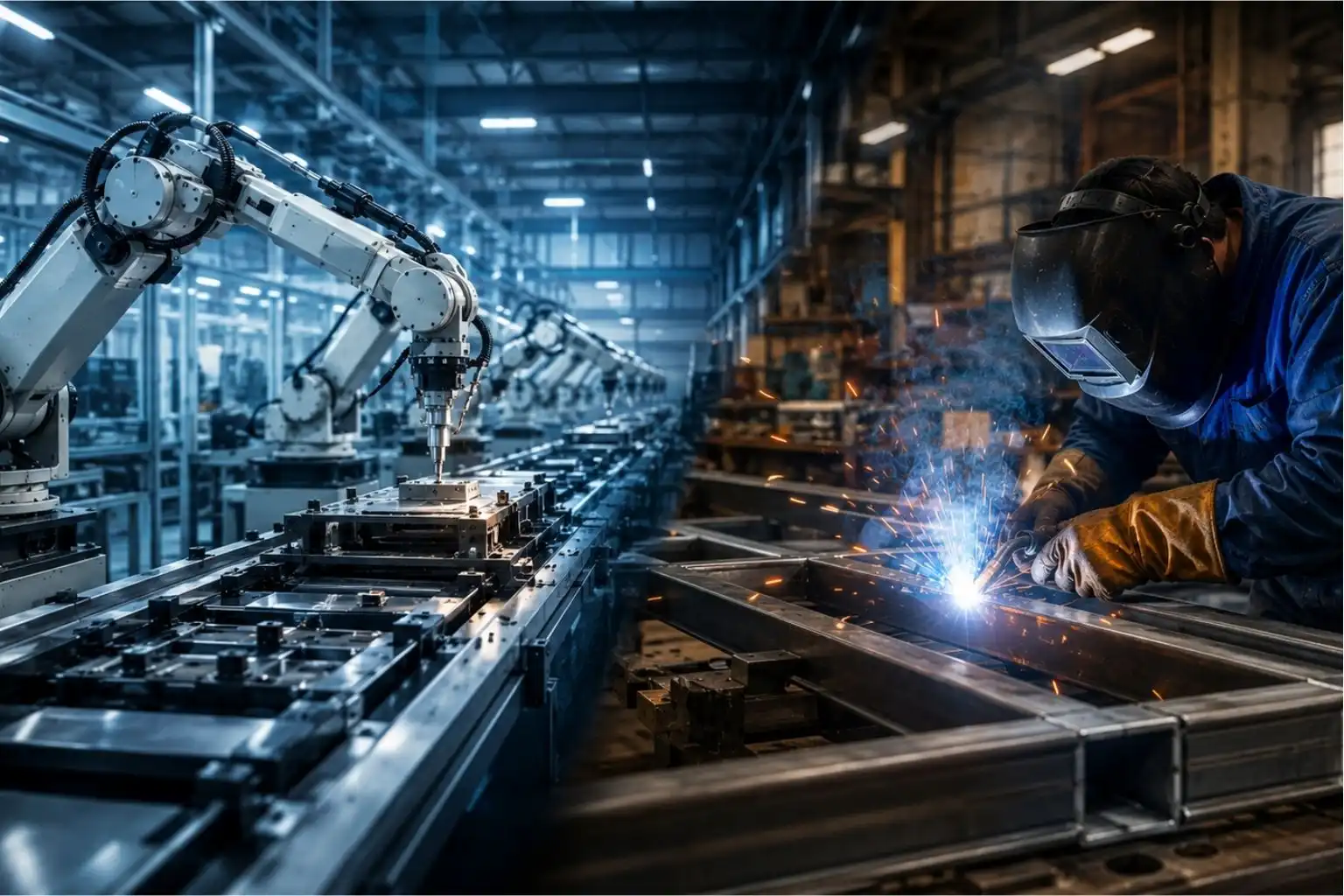
Businesses commissioning bespoke machinery, structural steelwork, or industrial components frequently encounter both terms and treat them as the same thing. In reality, manufacturing vs fabrication describes two distinct activities within the production process, each suited to different outputs, scales, and industries. According to Make UK, British manufacturers contribute over £217 billion to the UK economy each year and employ more than 2.5 million people.
Within that figure, fabrication plays a crucial supporting role, producing the specialist components and assemblies that feed into finished manufactured goods. Understanding the difference between manufacturing and fabrication helps engineers, procurement managers, and business owners make better decisions when choosing a production partner.
So, what exactly sets fabrication apart from manufacturing, and when does each process apply?
What Is Manufacturing?
Manufacturing is the end-to-end process of converting raw materials into finished products using machinery, tools, and labour. It covers every stage of production, from initial design and sourcing of raw materials through to assembly, quality testing, packaging, and final delivery. The defining characteristic of manufacturing is that it produces the final product and can include assembling, testing, packaging, and delivery.
Common sectors that rely on manufacturing include automotive production, aerospace, electronics, food and beverage, pharmaceuticals, and consumer goods, often at the scale of mass production. In each case, raw materials enter a production facility and a finished, sale-ready product exits; a good example is car production.
What Are The Main Types Of Manufacturing?
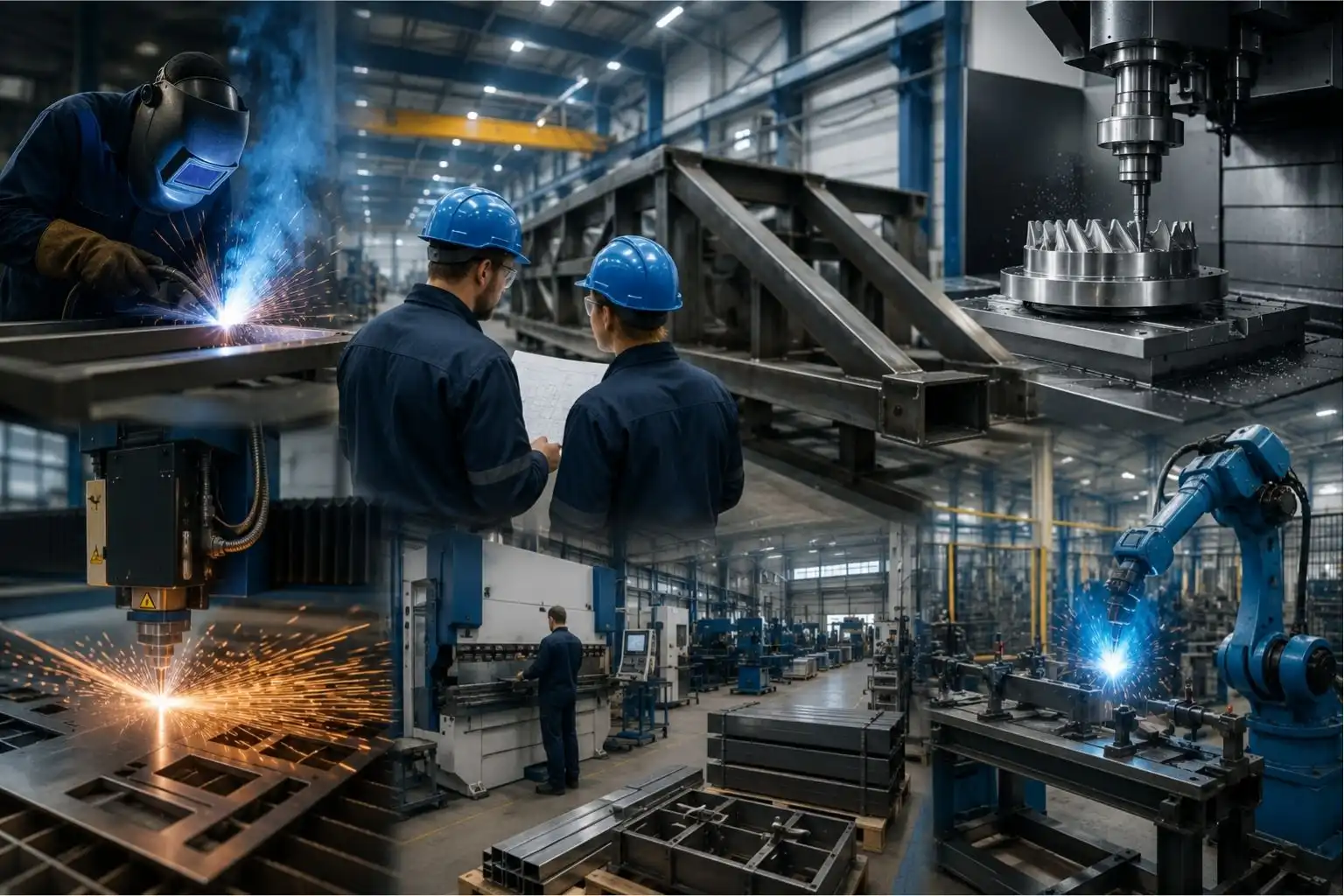
Manufacturing is not a single process. It takes several forms depending on the product type, required output volume, and level of customisation involved:
1. Repetitive Manufacturing
Identical products are produced continuously at high speed, such as automotive parts, electronic components, or packaged food. The emphasis is on maximising throughput and minimising unit cost. Assembly lines, automation, and robotics are central to this approach.
2. Discrete Manufacturing
Products are produced as distinct individual units but may vary between orders, often using standardised parts and separately produced individual components before products are completed as distinct units. Examples include furniture, industrial machinery, and appliances. Processes are standardised wherever possible, balancing product variation with production efficiency across different customer requirements and order volumes.
3. Job Shop Manufacturing
Small batches of highly customised or specialised products are produced to specific customer requirements. Common in mechanical engineering workshops and prototype production, no two orders are exactly alike. Lead times are longer, but the degree of customisation is high.
4. Batch Process Manufacturing
Products are produced in defined batches within a set timeframe, then the production line is reconfigured for the next run. Pharmaceuticals, chemicals, and specialist coatings are commonly manufactured this way, balancing efficiency with flexibility.
5. Continuous Process Manufacturing
Non-stop production of high-demand products such as petroleum, steel, or paper runs 24 hours a day with minimal interruption. This approach prioritises maximum output, operational consistency, and cost efficiency across large-scale industrial facilities.
What Is Metal Fabrication?
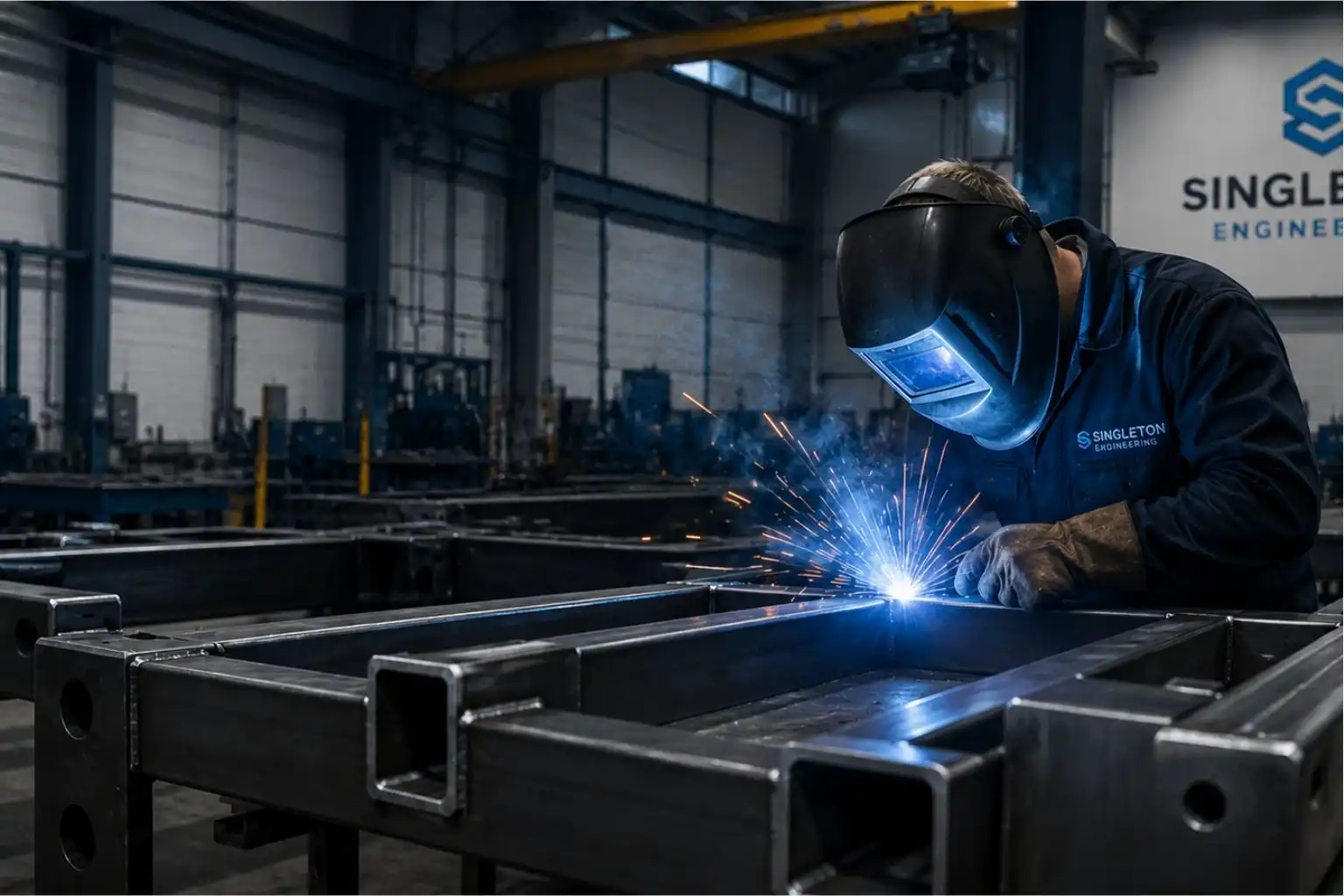
Fabrication, or production fabrication, is a more specific industrial process: fabrication involves cutting, bending, welding, and assembling materials into components, structures, or assemblies, typically metals. Fabricated items are not typically finished consumer products. They are components or structural assemblies that are integrated into a larger system or product during the manufacturing stage.
In practical terms, fabrication means taking raw or semi-finished manufactured materials and transforming them into a precise, functional component using one or more specialist processes. The resulting part is accurate, durable, and designed to meet tight tolerances, and one company may fabricate specialist parts that another manufacturer later integrates into a larger system.
Technically, fabricating is the act of constructing a component through physical processes rather than chemical or biological ones. The fabricated item has form, dimension, and function, but fabrication is focused on making components rather than delivering the final product.
What Processes Are Used In Fabrication?
Fabrication encompasses a wide range of forming and joining techniques, and the most common fabrication methods include several common fabrication methods used across different processes:
- Cutting: Laser cutting, plasma cutting, water jet cutting, and mechanical shearing are used to produce precise shapes from sheet metal, metal sheets, or plate steel; laser cutting can achieve tolerances as small as 0.15mm.
- Welding: MIG, TIG, and arc welding are welding methods and welding techniques used to join metal sections together to create rigid structures, assemblies, and frames.
- Bending and folding: Press brakes and roll bending equipment shape flat metal into angled, curved, or tubular forms.
- Stamping and punching: Presses create holes, slots, and formed profiles in sheet metal at high speed for complex designs.
- Machining: CNC milling, turning, and drilling produce precision features such as threads, bores, and surface finishes.
- Assembly: Sub-components are combined using fasteners, adhesives, or welding to produce finished assemblies and support complete assembly.
Finishing steps such as powder coating are also commonly applied after fabrication for protection and durability.
Modern fabrication relies on computer aided designs and Computer Numerical Control (CNC) technology to support complex designs and maintain quality standards across different processes, while reducing material waste. Rigorous maintenance and inspection protocols ensure every component meets specification. Bespoke machinery and custom tooling are often developed specifically for projects where standard equipment cannot meet the required demands.
Manufacturing vs Fabrication: What Sets Them Apart?
Manufacturing covers the complete production journey from raw material to finished product. Fabrication is a stage within that journey, and areas such as metal fabrication and steel fabrication focus on producing precise components or assemblies for metal products and metal structures. The steel sections in a bridge are fabricated; the bridge itself is manufactured from those sections.
The table below summarises the key differences between fabrication and manufacturing across the dimensions that matter most to engineering and industrial businesses:
| Aspect | Fabrication | Manufacturing | Scale | Key Industries |
| Definition | Constructing components or assemblies from raw or semi-finished materials | Converting raw materials into finished goods from start to end | Small to medium runs | Construction, aerospace, defence |
| Output | Components, structures, sub-assemblies | Finished, consumer-ready or industry-ready products | Varies by order | Metalworking, automotive |
| Processes | Cutting, welding, bending, stamping, CNC machining | Casting, forming, assembly, testing, logistics | High volume | Electronics, pharma, food |
| End user | Typically other businesses (B2B) | Consumers or commercial end users | Mass market | FMCG, retail, automotive |
| Customisation | High, bespoke to specification | Standardised, designed for repeatability | Low to medium | Consumer goods, electronics |
Both processes are fundamental to modern industry, and understanding where each fits within the production cycle helps businesses make smarter decisions when selecting the right production partner. For businesses commissioning fabricated components or a fully manufactured end product, knowing the distinction ensures clearer briefs, stronger supplier relationships, and better outcomes, especially as fabrication plays a key role across many industries.
How Do Fabrication And Manufacturing Work Together
Fabrication and manufacturing are not competing approaches. They are sequential stages of the same supply chain, with one company often supplying fabricated parts while another handles broader manufacturing or final integration. Examples across industry include:
- Automotive: Steel fabricators produce the chassis frame, body panels, and exhaust components to specification, creating individual components before they move to the assembly line. These are then combined with engines, electronics, and interiors on the manufacturing assembly line to produce a finished vehicle.
- Construction: Structural steel beams and columns are fabricated in a workshop, often off-site, then assembled on-site to form the completed building frame.
- Aerospace: Each major aircraft section is fabricated by specialist suppliers before final assembly by the manufacturer. A Boeing 787 Dreamliner contains over 2.3 million rivets and 38 miles of welded seams, all produced through precise fabrication.
- Bespoke Machinery: Custom frames, housings, and structural components are fabricated in-house as part of fabrication services, then combined with manufactured components such as motors, bearings, and controllers for complete assembly in the finished machine. This also applies in agriculture, where fabricated components are widely used in agricultural machinery.
- Electronics: Display screens for smartphones and tablets are fabricated by specialist manufacturers. Brands such as Apple and Samsung then integrate those fabricated displays into finished devices on their manufacturing lines.
What makes this collaboration possible is the precision achieved at the fabrication stage. Processes such as laser profiling ensure every component is cut and formed to exact tolerances before it supports the wider manufacturing supply chain, reducing errors, minimising rework, and keeping production on schedule.
Signs You Need A Fabricator Rather Than A Manufacturer
The choice between a fabrication specialist and a traditional manufacturer depends on the nature of the project. Fabrication is the right approach when:
- You need CAD-driven custom work, including components or structural assemblies built to a specific engineering drawing, and fabrication can support complex designs.
- Your metal fabrication requirements include cutting, welding, bending, or machining structural or functional parts to drawing.
- You require small to medium production runs with tight tolerances and strict quality control.
- You are outsourcing part of your own manufacturing process to a precision specialist.
- Your project involves bespoke machinery, industrial frameworks, or specialist equipment.
- You need fabricated sub-assemblies or complete assemblies for integration into your own manufacturing or assembly operation.
If you are producing large volumes of standardised, consumer-ready products using raw materials at scale, you are looking for a manufacturer. If you need precision components, structural assemblies, or custom-built engineering solutions produced to specification, you need a fabricator.
Get Expert Fabrication And Manufacturing Support Today
Understanding the difference between manufacturing vs fabrication is the first step to choosing the right production partner for your project, and real-world examples include bespoke machinery, structural steelwork, precision CNC machined components, or complex assemblies where both are needed. For bespoke machinery, structural steelwork, precision CNC machined components, or complex assemblies, working with a specialist who understands both processes ensures your project is delivered accurately, on time, and to specification.
At Singleton Engineering, we combine deep fabrication expertise with full manufacturing capability, offering fabrication and manufacturing support as a service that handles diverse processes under one roof, from initial design and material selection through to final assembly, testing, and delivery. View our Maintenance and Inspection services to ensure your fabricated components and manufactured systems continue to perform reliably long after installation.
Contact us at office@singletonengineering.co.uk or 01282 423198 to discuss your project requirements today.
Frequently Asked Questions About Manufacturing vs Fabrication
What does fabrication mean in an engineering context?
In engineering, fabrication means constructing a component, structure, or assembly from raw materials through physical forming and joining processes. It’s often using materials such as mild steel to create metal structures or components. Fabricating, specifically, is the act of shaping metal or other materials into a precise, functional part using techniques such as laser cutting, welding, bending, stamping, or CNC machining, with different processes used depending on the application.
Fabricated parts are not standalone finished products. They are designed to fit within a larger assembly or production process, contributing directly to the finished manufactured output and meeting the exact dimensional and structural requirements of the application.
What is production fabrication?
Production fabrication refers to the systematic, repeatable fabrication of components in defined quantities for supply to a manufacturing or assembly operation. Unlike one-off prototyping, production fabrication requires consistent quality, tight dimensional control, and the ability to meet volume requirements across multiple production runs.
It sits at the intersection of fabrication and manufacturing, bridging specialist component production with broader industrial output, ensuring supply chain continuity, and supporting manufacturers in delivering finished products reliably and on schedule.
Can a fabricator also be a manufacturer?
Yes. Many engineering companies perform both fabrication and manufacturing within the same facility, particularly for bespoke or custom projects. A company might fabricate custom steel components in-house and assemble them with bought-in parts to deliver a finished product.
This integrated approach reduces lead times, improves quality control, and eliminates the cost and complexity of moving work-in-progress between separate suppliers, making it a practical and efficient solution for custom production.
What is the lifespan of fabricated metal components?
The lifespan of fabricated metal components depends on the material, fabrication quality, operating environment, and maintenance regime. Structural steel fabrications in protected environments can last decades with appropriate surface treatment.
Components exposed to harsh conditions, high temperatures, or corrosive environments require specialist materials or coatings. Working with experienced fabrication specialists ensures the right specification for your application and longevity requirements.