


Getting the budget wrong can stall essential building work, trigger compliance issues, and lead to emergency repairs that cost far more than a properly planned project. Mechanical installation is one of the most significant investments in any construction or refurbishment programme, and many property owners, facilities managers, and developers underestimate how widely the final figure can vary based on system type, building size, and project complexity.
According to 2026 industry data, HVAC engineers in the UK typically charge between £210 and £330 per day nationally, with London and South East specialists commanding £265 to £470 per day. Understanding what drives these rates, and how they translate into total project costs, is essential before requesting quotes. So how much do mechanical installation services cost in the UK, and what factors shape the price you can realistically expect to pay?
What Are Mechanical Installation Services And What Do They Include?
For those new to the discipline, what is mechanical installation is one of the most common questions at the planning stage of a building project. Mechanical installation is the skilled trade practice of designing, supplying, fitting, and commissioning systems that control the movement of air, water, gas, steam, and other fluids through a building or facility, including the integration of machinery into electrical and hydraulic networks. For property owners, facilities managers, developers, and anyone overseeing construction or refurbishment work, understanding that scope helps with budgeting, compliance, contractor selection, and avoiding costly system failures later on.
The core categories covered by mechanical installation services in the UK include:
- HVAC (Heating, Ventilation, and Air Conditioning) systems
- Boilers, heat pumps, and warm air heating systems
- Plumbing, domestic water supply, and sanitation systems
- Process piping and industrial pipework
- Mechanical ventilation and air handling units (AHUs)
- Ductwork fabrication and installation
- Fire suppression and sprinkler systems (mechanical component)
- Building management systems and temperature controls
- Pumps, turbines, and compressors as installed plant
- Laser profiling and precision measurement for pipework and ductwork systems .
This work typically takes place after the structural completion of a facility.
Commercial mechanical installation typically involves a greater level of regulatory compliance, system complexity, and coordination with other building trades than residential work. On industrial projects, Mechanical Fitters commonly work with stainless and carbon steels and plastics to assemble and install these systems. For a closer look at how mechanical engineers operate across more complex environments, see our guide on What Mechanical Engineers Do In Industrial Manufacturing. This guide explains what mechanical installation involves, typical UK costs and the factors that affect them, how to compare mechanical installation companies, and answers to common questions about the service.
What Is The Average Cost Of Mechanical Installation Services In The Uk?
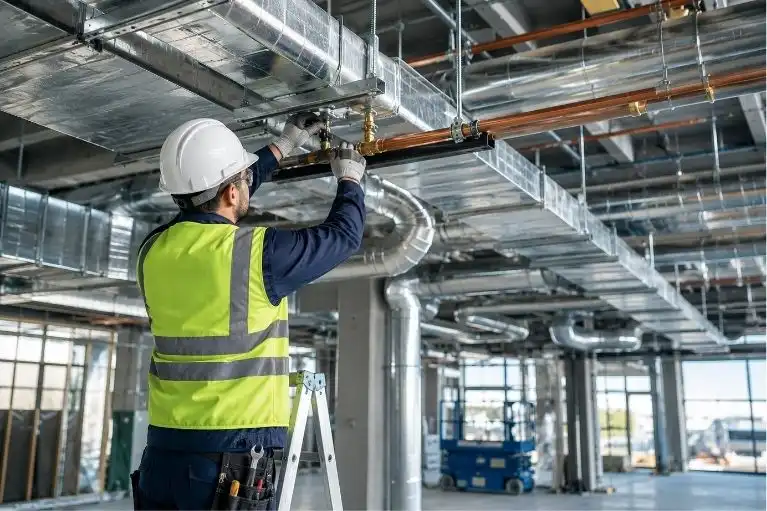
If you are asking what mechanical installation involves and how much it costs in the UK, the answer depends on several project-specific variables. Mechanical installation services cover the design, supply, fitting, and commissioning of systems that move air, water, gas, and other fluids through a building or industrial facility, and HVAC pricing in particular depends on accurate load calculations.
The most common categories include HVAC systems, boilers, plumbing and pipework, ductwork, mechanical ventilation units, air handling units, and fire suppression systems. Across residential, commercial, and industrial projects in the UK, mechanical installation costs vary considerably. The table below sets out indicative 2025 to 2026 pricing ranges based on current market data:
| Service Type | Typical UK Cost Range | Notes |
| Boiler replacement (combi, supply and fit) | £1,800 – £3,000 | Like-for-like; system boilers up to £3,500 |
| Boiler replacement (regular/conventional) | £2,500 – £4,500 | Including installation; larger homes |
| Residential HVAC / air con (single split unit) | £800 – £2,000 | Supply and install; wall-mounted unit |
| Residential multi-split system (3–4 rooms) | £3,500 – £7,000+ | Multiple indoor units, one outdoor |
| MVHR system (150m² home, supply & commission) | £5,267+ | Plus £3,700 installation by third party |
| Small office HVAC (up to 250m²) | £6,000 – £12,000 | Access and zoning dependent |
| Commercial AC installation (general) | £3,500 – £70,000+ | By building size and system type |
| HVAC engineer day rate (national) | £210 – £330/day | London/South East: £265–£470/day |
| Plumber hourly rate (standard) | £40 – £70/hour | Varies by region; London can exceed £120/hr |
| M&E systems as % of healthcare build cost | 35–50% of total | Vs 15–25% in standard residential buildings |
Every project is different, and these figures should be treated as starting points rather than fixed prices. Proper installation can improve operational efficiency by up to 15%, which is one reason more efficient, fully operational systems may attract different quotes depending on installer quality as well as scope. A professional site survey and detailed quotation from qualified mechanical installation companies remain the most accurate way to budget for any project.
Factors That Affect Mechanical Installation Costs

Understanding what drives your mechanical installation price helps you budget accurately, compare quotes fairly, and avoid unexpected costs once work is underway. Several variables consistently push costs up or down across all project types in the UK.
1. Project Scope, Project Management, And System Complexity
Larger buildings require more equipment, longer pipe and duct runs, and more labour hours. Multi-storey structures need separate zoning systems, which adds to both material and installation costs. Complex layouts and specialist systems such as smart HVAC or building management system integration increase the labour required for mechanical equipment installation, and Building Information Modeling helps coordinate installations effectively by resolving key details early.
2. Labour Costs And Regional Variation
Labour represents a significant share of any mechanical installation project. Experienced contractors rely on time-served operatives who are competent in health and safety, and that expertise affects labour rates when teams are working to tight programmes. HVAC engineers charge £210 to £330 per day nationally, while plumbers charge £40 to £70 per hour for standard work. London and the South East command up to 40 percent above national averages for mechanical installation services, and emergency callouts attract surcharges of 50 to 150 percent above standard rates.
3. Material Costs And Supply Chain Conditions
Copper, steel, and refrigerant prices fluctuate based on commodity markets and supply chain conditions. The UK construction sector faced sustained cost pressures throughout 2024 and 2025, and the ongoing F-Gas phase-down continues pushing refrigerant costs higher. When comparing quotes from mechanical installation companies, always confirm whether material pricing is fixed or subject to market adjustment before work begins.
4. Regulatory Compliance And UK Building Regulations
Compliance costs are frequently underestimated across all mechanical installation projects. Key UK requirements include Gas Safe registration for gas boiler work, F-Gas certification for refrigerant handling, OFTEC registration for oil boiler installation, and MCS accreditation for heat pump installations eligible for the Boiler Upgrade Scheme, which currently offers £7,500 towards qualifying projects. Each step must also follow OEM guidelines to avoid warranty issues and compliance problems.
5. Urgency, Timing, And Seasonal Demand
Emergency callouts can reach £80 to £120 per hour or more across the UK. Demand for HVAC engineers peaks sharply during summer months, pushing both rates and lead times higher. Scheduling commercial mechanical installation earlier in the year and combining it with a planned preventive maintenance contract can reduce overall project costs considerably. Larger installations may also require cranes and rigging for the safe handling and positioning of machinery, which can affect programme timing, cost, and deadlines.
6. Hidden Structural And Site Conditions
Hidden site issues are one of the most common reasons mechanical installation budgets overrun on UK projects. Professional estimators recommend a contingency allowance of five to ten percent of total project value, with a higher allowance factored in for older properties, listed buildings, and sites where previous system condition is unknown.
How To Choose Between Mechanical Services Installation Companies
When comparing mechanical installation companies in the UK, price is only one part of the decision. Installation quality has a direct impact on system performance, compliance, energy efficiency, and long-term maintenance costs. Good contractors also protect safety by isolating energy sources before installation work begins. Choosing a contractor with the right accreditations and experience is at least as important as securing a competitive quote.
Key factors to evaluate when selecting mechanical installation services providers include:
- Gas Safe registration: required for any work involving gas boilers or gas supply systems, and non-negotiable for all domestic and commercial heating installations.
- F-Gas certification: legally required for engineers handling, recovering, or recharging refrigerants on air conditioning and refrigeration systems.
- OFTEC registration: essential for oil boiler installation and servicing, confirming the engineer meets the required competency standards.
- MCS accreditation: needed to access the Boiler Upgrade Scheme grant of £7,500 for eligible heat pump installations.
- CIBSE membership or equivalent: confirms the contractor meets recognised standards for commercial HVAC design, specification, and oversight roles.
- Demonstrated experience: look for a proven track record with projects of similar scale, building type, and system complexity to your own.
- A transparent, itemised quotation: separating labour, materials, plant, permits, and contingency so you can compare quotes fairly across mechanical installation companies.
- Clear project timeline: with defined milestones and communication protocols so you know what to expect at every stage of installation.
- System testing procedures: confirm mechanical testing is included to verify all components are fully functional, along with pressure tests and air/water balancing before handover.
- Machinery base preparation: precision leveling and grouting are essential to prevent vibration and premature wear.
- Verified alignment checks: precision alignment helps prevent operational failure in rotating machinery.
- Warranty and post-installation support: covering all installed systems, including commissioning certification, support through project completion, and a planned maintenance schedule.
- Maintenance and inspection schedule: confirm the contractor offers post-installation servicing, system checks, and scheduled inspections as part of their long-term support offering.
Always request at least three quotes before committing to a contractor, and never base the decision on price alone, the quality of mechanical installation directly affects how safely, efficiently, and reliably your systems perform for years to come.
Get An Accurate Quote For Your Mechanical Installation Project Today
The answer to how much mechanical installation costs depends on more than a single estimate, especially since projects can vary widely by building type, system complexity, and site conditions. System type, labour rates, materials, regulatory compliance, and hidden structural issues all influence the final mechanical installation cost. While average pricing provides a useful starting point, the best way to understand the total cost before work begins is through a professional site survey and clear, itemised quotation.
If you are comparing mechanical installation services across the UK or planning a commercial mechanical installation project, Singleton Engineering can help. We can provide free site surveys, transparent quotations, and expert guidance tailored to your building and system requirements. Check out our Mechanical Engineering Services page or contact us a office@singletonengineering.co.uk or call 01282 423198 for accurate mechanical installation cost estimates and support with your next project.
Frequently Asked Questions About Mechanical Installation
What is mechanical installation?
Mechanical installation is the skilled trade practice of designing, supplying, fitting, and commissioning systems that control the movement of air, water, gas, steam, and other fluids through a building or facility. It covers a broad range of work including HVAC systems, boilers, plumbing and pipework, ductwork, mechanical ventilation units, fire suppression systems, and building management controls.
Mechanical installation is a core discipline within MEP (Mechanical, Electrical, and Plumbing) construction and applies to residential, commercial, and industrial building types across the UK, from a single house or small domestic property to large-scale commercial and healthcare facilities.
What is included in mechanical installation costs?
Mechanical installation costs typically cover several components beyond the equipment itself. Labour charges account for the engineer’s time, expertise, and regulatory accreditations such as Gas Safe or F-Gas certification. Material costs include pipework, ductwork, fittings, insulation, and any specialist components required for the system type.
Additional costs to factor in include site surveys, permits, building control notifications, commissioning, system testing, waste removal, and checks to ensure rotating machinery is properly aligned where relevant. Proper alignment can improve operational efficiency by up to 15%. Soft costs such as engineering design fees and project management are also frequently overlooked. A contingency allowance of five to ten percent is recommended to cover unforeseen site conditions discovered once work begins.
Is it cheaper to repair or replace mechanical systems?
The right decision depends on system age, condition, and repair history. Minor faults such as component failures or valve issues are usually more cost-effective to repair on systems in good overall condition. However, repeated repairs on ageing equipment such as pumps, turbines, and compressors may not resolve underlying deterioration, and investing in a full mechanical installation often delivers stronger long-term value through improved efficiency, lower energy bills, and reduced maintenance costs.
As a general rule, if repair costs exceed 50 percent of the price of a new system, replacement is typically the more financially sound decision. Newer systems also benefit from improved energy ratings, reduced carbon emissions, and longer manufacturer warranties. In some cases, new equipment can also reduce downtime when older plant has become unreliable. A professional inspection helps identify the most cost-effective route for your property.
Do I need planning permission for mechanical installation in the UK?
In most cases, standard mechanical installation work such as boiler replacements, air conditioning units, and ventilation systems does not require planning permission, as it falls under permitted development rights. However, exceptions apply in certain situations. Properties in conservation areas, listed buildings, or national parks may require consent before external units or flues are fitted.
Installations that involve significant structural changes or affect the external appearance of a building may also trigger a planning application. Always check with your local planning authority before work begins, and ensure your contractor is familiar with the specific permitted development rules that apply to your property type. Contractors should also meet local authority and building requirements before installation proceeds.