

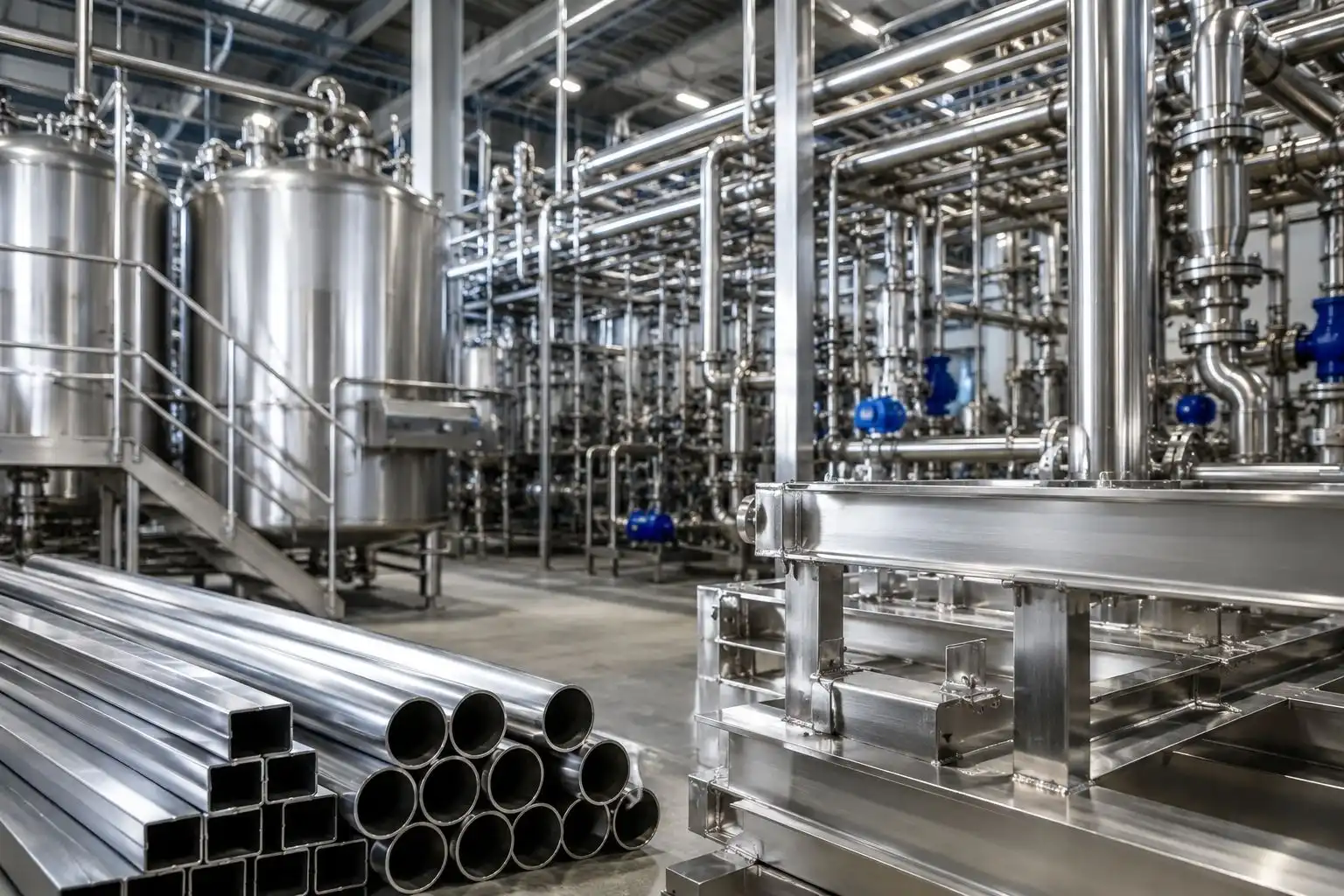
Cheap materials often seem like a smart way to cut costs, yet they frequently lead to premature corrosion, unexpected repairs, and expensive downtime that outweigh any initial savings. In the UK, manufacturers generated £452 billion in product sales during 2025, highlighting the scale of an industry where durable, reliable materials play a major role in keeping operations running efficiently.
With production worth hundreds of billions of pounds each year, even a small reduction in maintenance costs or equipment failures can make a significant difference to long-term profitability.
So, why are so many industrial firms investing in stainless steel fabrication instead of lower-cost alternatives?
What is Stainless Steel Fabrication?
Stainless steel fabrication covers every stage that turns raw sheet, plate or section into a finished component: cutting, forming, joining and finishing. It is not the same job as working mild steel or aluminium. The alloy work hardens quickly and reacts badly to uncontrolled heat input, so stainless fabrication needs specific equipment, tighter process control, and stainless steel fabricators who understand how the material behaves before it is cut.
Main Benefits of Stainless Steel Fabrication?
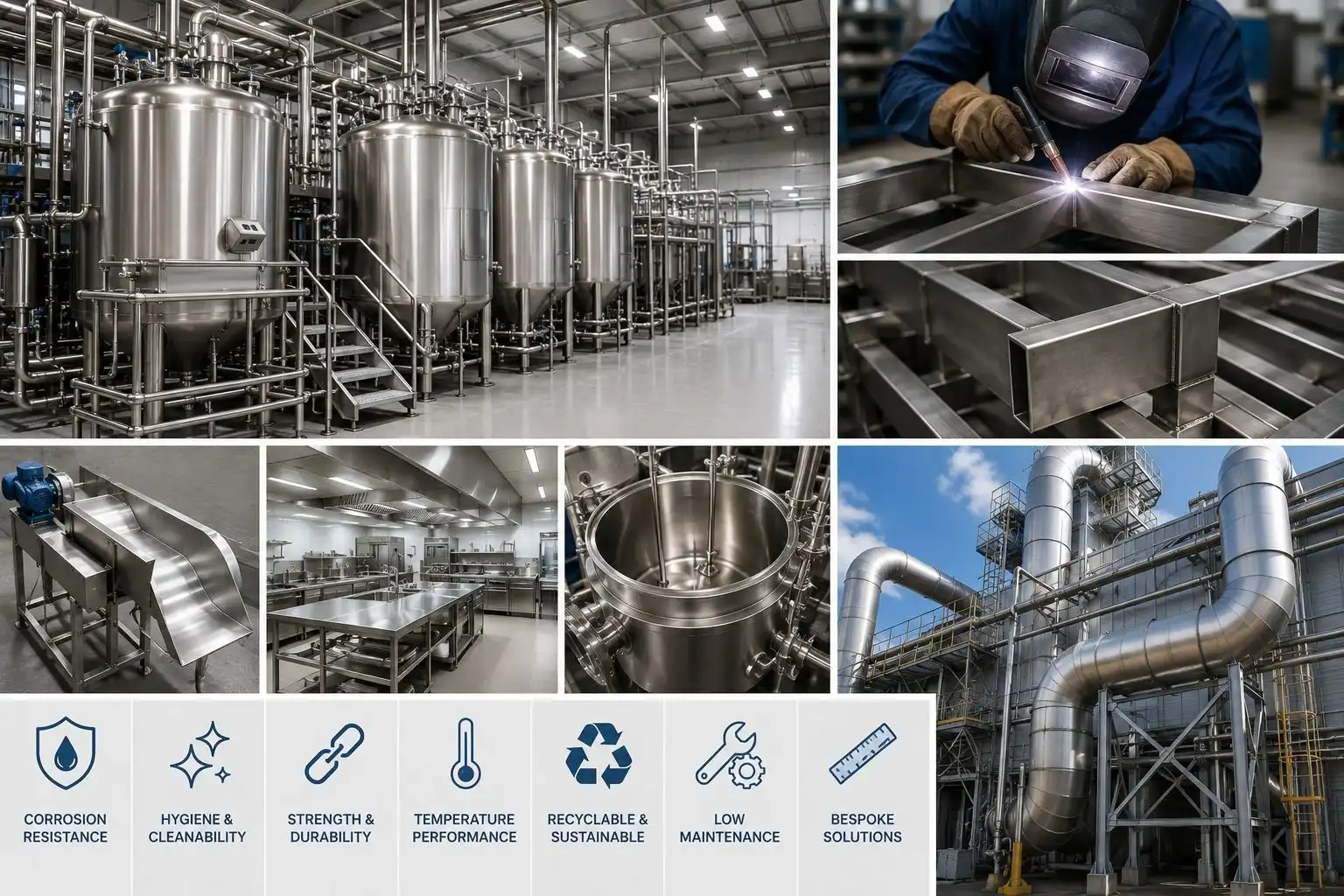
Here are the reasons industrial buyers keep specifying stainless steel fabrication, and what each one is actually worth once the component is installed and working.
1. Corrosion Resistance That Maintains Itself
This is the defining property and the one most decisions rest on. Stainless contains a minimum of 10.5 per cent chromium, which forms a passive oxide layer across the surface. Damage the layer and it reforms on contact with oxygen, so there is no coating to inspect, strip or reapply.
That protection holds up against atmospheric corrosion in industrial and coastal locations, against water and chemical solutions, and against galvanic attack where dissimilar metals meet. Chloride environments are the exception worth flagging, since pitting and crevice corrosion can still occur if the grade has been chosen carelessly.
Stainless steel also has a long lifespan because its rust-resistant surface continually renews itself in service. Match the grade to the environment and the component simply carries on working, which is why industrial stainless steel fabrication dominates in chemical processing, food manufacturing, wastewater treatment and energy production, and is especially suitable where long-term corrosion performance is critical. Most stainless steel fabricators will steer a specification on this basis before anything else is considered.
2. Hygiene, Cleanability And Appearance
The surface is smooth and non porous, so there is nothing for bacteria to colonise and nothing to trap residue. It withstands aggressive cleaning chemicals and high temperature sterilisation without degrading, which is what makes it standard across the food processing industry, food and beverage production, pharmaceutical manufacturing, healthcare and commercial kitchens.
Appearance follows from the same property rather than being a separate benefit. Because there is no paint or coating to chip and flake, surfaces still look serviceable after years in production, and there is nothing shedding into product.
That matters commercially at audit and practically on a wash down line, where a flaking coating is both a maintenance job and a contamination risk and can prevent equipment meeting hygiene specifications in audited environments. It is also why hygiene led sectors buy stainless steel fabrication services rather than sourcing coated alternatives. For food equipment, stainless can help break the mould compared with coated alternatives because the finish resists chipping and contamination.
3. Strength And Design Freedom
Good strength to weight allows thinner sections, which reduces assembly weight, simplifies handling on site and cuts the supporting structure needed underneath. Cold working during forming increases strength further, so designers can use less material rather than more.
The material also forms into almost anything. Stainless fabrication covers thin covers and guards through to reinforced structural frames, taking in enclosures, chutes, brackets, hoppers, ductwork, tanks, machine frames and countertops along the way as stainless steel products.
Finishes run from industrial matt to mirror polish depending on what the application needs. This range is why stainless fabrication produces such varied work from the same stock material, and why stainless steel fabricators are asked to move between structural and precision jobs on the same site, including complex stainless steel fabrications built to exact customer specifications.
4. Performance Across The Temperature Range
Grade selection opens up a very wide working range. Austenitic grades stay ductile at cryogenic temperatures, which suits chilled and frozen production, while other grades hold their properties under sustained heat. The same material family therefore serves a blast freezer and an oven line, which removes a specification headache when a single production line spans both.
5. Recyclability And Long Service Life
Stainless is fully recyclable without any loss of properties, and current production carries a substantial proportion of recycled content. Scrap retains value at end of life, so recovery happens as a matter of course rather than needing to be mandated.
The bigger environmental gain is simply that components last. A frame that does not need replacing every few years generates no replacement material, no disposal and no installation work. For sites working toward green building certification or carbon reduction targets, that longevity usually counts for more than the recycling figure.
6. Lower Whole Life Burden
Upfront the material asks more than carbon steel. Across the asset life it usually asks less, because there are no coatings to reapply, no repeat repairs and no early replacement. Maintenance drops to cleaning in most environments, so a planned maintenance and inspection routine replaces reactive repair work, and the downtime that comes with taking a line out of service largely disappears.
Firms buying stainless steel fabrication services are generally buying a more efficient and predictable outcome rather than the metal itself, and it is the argument industrial stainless steel fabrication is usually justified on internally, which is how firms achieve lower whole-life cost.
7. Suitability For Bespoke Work
Off the shelf components rarely match the dimensions, fixing points or clearances of plant already installed, which is why so much bespoke stainless steel fabrication is one off rather than catalogue. Fitting a new assembly to an existing line is a mechanical engineering question as much as a fabrication one, since the component has to work with the drives, guarding and access arrangements already around it.
Laser profiling, CNC bending and controlled welding now produce parts to tight tolerances and repeat them consistently across a run, so bespoke stainless steel fabrication no longer carries the lead time penalty it once did. That capability is now the reason most bespoke stainless fabrication is specified rather than adapted from stock.
That combination of capability and material performance is what stainless steel fabricators UK wide are being asked for. Providers of stainless steel fabrication UK wide differ mainly in how many of those stages they handle in house, and stainless steel fabricators UK wide vary more on that point than on the metal itself. Anyone comparing stainless steel fabrication UK suppliers should establish it before a project starts rather than during it.
Which Stainless Steel Fabrication Methods Are Used?
Every fabricated component is cut, formed, joined and finished, but stainless work hardens, holds heat and marks easily, so each stage needs tighter control than mild steel. Here are the different types:
Cutting and Profiling
Cutting brings stock down to size and shape. Five methods cover most industrial stainless steel fabrication work, and they trade accuracy against speed, thickness and heat.
| Method | How it works | Best for | Trade off |
| Mechanical shearing | Opposing blades cut through sheet and plate | Fast straight cuts in thinner material | Straight lines only, edge may need dressing |
| Plasma | An ionised gas jet melts and blows material away | Thicker sections and rough contours | Wide heat affected zone, edge needs finishing |
| Laser | A focused beam melts or vaporises a narrow kerf | Accurate, repeatable profiles in sheet and plate | Thickness ceiling, higher plant investment |
| Waterjet | Abrasive carried in a high pressure water stream | Heat sensitive work and thick sections | Slower than thermal cutting |
| Saw and abrasive | Mechanical cutting through wheel or blade | Structural sections and site work | Slow, generates heat, consumables wear |
Laser profiling has become the default for most sheet and plate work because it combines tight tolerances with repeatability across a production run, which matters when parts have to fit an assembly without adjustment. Waterjet earns its place where heat is the problem rather than the material, since it introduces none at all. Plasma remains the sensible answer on heavy sections where the edge will be dressed or welded anyway.
Forming and Bending
Forming turns flat material into a three-dimensional shape. Press brake bending covers most of it, using a punch and die to fold sheet and plate along a line, with CNC control allowing multiple bends in sequence.
Four things govern whether a bend comes out right:
- Bend radius. Austenitic grades typically need a minimum radius of one to two times material thickness. Tighter than that and the outer face can crack.
- Springback. The material relaxes slightly after the tool releases, so the bend is overformed to land on the target angle.
- Bend allowance. Material stretches through the bend, so flat pattern development has to account for it, or the finished dimensions drift.
- Work hardening. Each operation leaves the material harder than it was, which changes how it behaves on the next bend in the sequence.
Beyond press work, roll forming pulls sheet through successive rollers to produce long, consistent profiles, though the tooling investment only makes sense on volume. Stamping and deep drawing press material into dies to form vessels and pressed components, sometimes needing intermediate annealing to relieve work hardening between stages.
Hydroforming uses fluid pressure to push material into a die, which suits complex shapes needing even wall thickness. For most bespoke stainless fabrication, press brake work and laser profiling together cover the majority of components.
Machining
Machining removes material to hit dimensions or produce features that forming cannot. Turning, milling, drilling and grinding all apply, but each needs adjusting for the way stainless behaves under a cutting edge.
The common thread is heat and work hardening. Cutting speeds run lower than for carbon steel, coolant flow matters more, and carbide tooling is standard rather than optional. Cuts are kept continuous wherever possible, because a tool that dwells or rubs glazes the surface and leaves a hardened layer for the next pass to fight through. Drilling follows the same logic, with firm feed rates used deliberately to stay ahead of that layer rather than skating on top of it.
Grinding then brings components to final dimension where tolerances are tight, and handles deburring before assembly. Firms offering stainless steel fabrication services will usually combine machining with profiling and welding in-house, which avoids parts moving between suppliers mid-build. That matters most on bespoke stainless steel fabrication, where a single component may pass through three processes before it is finished.
Welding and Joining
Welding is where most stainless jobs are won or lost, because heat input directly affects corrosion performance. Two processes dominate industrial stainless steel fabrication.
- TIG. A tungsten electrode with inert gas shielding. Slower and more operator-dependent, but it gives precise heat control and a clean weld, which is why it is specified for food, pharmaceutical, and hygienic work. Back purging is often needed to stop the reverse side oxidising.
- MIG. A continuously fed wire with shielding gas. Faster and easier to automate, better suited to thicker material and production volume, with some spatter to clean up afterwards.
Stick welding still appears occasionally on site work but has largely given way to the two above. Resistance welding suits high-volume assembly where filler is not wanted. Brazing joins without melting the parent metal, which suits heat exchangers and fittings. Mechanical fastening remains the right answer whenever a joint has to come apart again, or where dissimilar metals are involved.
Whichever process is used, the weld is not finished when the arc stops. Heat tint left on the surface is depleted of chromium and will corrode, so competent stainless steel fabricators clean welds back properly rather than leaving them coloured.
Surface Finishing
Finishing is not cosmetic in stainless fabrication. It determines how easily a surface cleans, how well it resists corrosion, and whether it passes a hygiene audit.
- Brushed and satin finishes. Produced by abrasive belt work. The No. 4 brushed finish is the general-purpose specification for equipment and architectural work.
- Polishing. Progressively finer abrasives lift reflectivity through to a mirror finish, used where appearance carries weight.
- Electropolishing. An electrochemical process that removes a microscopic surface layer, leaving a smoother finish that resists bacterial adhesion and enriches the chromium at the surface. Standard for pharmaceutical and high-care food equipment.
- Pickling and passivation. Pickling strips scale and heat tint left by welding. Passivation removes free iron and restores the chromium oxide layer, returning the corrosion resistance to full strength.
- Bead blasting. Creates an even matt surface, either for appearance or as preparation for a coating, and may be followed by powder coating where a coated finish is required.
Pickling and passivation are the steps most often skipped on price and most often regretted. A stainless assembly that has been welded and not cleaned back is carrying free iron and heat tint on the very surfaces it needs to protect.
Which Industries Rely on Stainless Steel Fabrication Most?
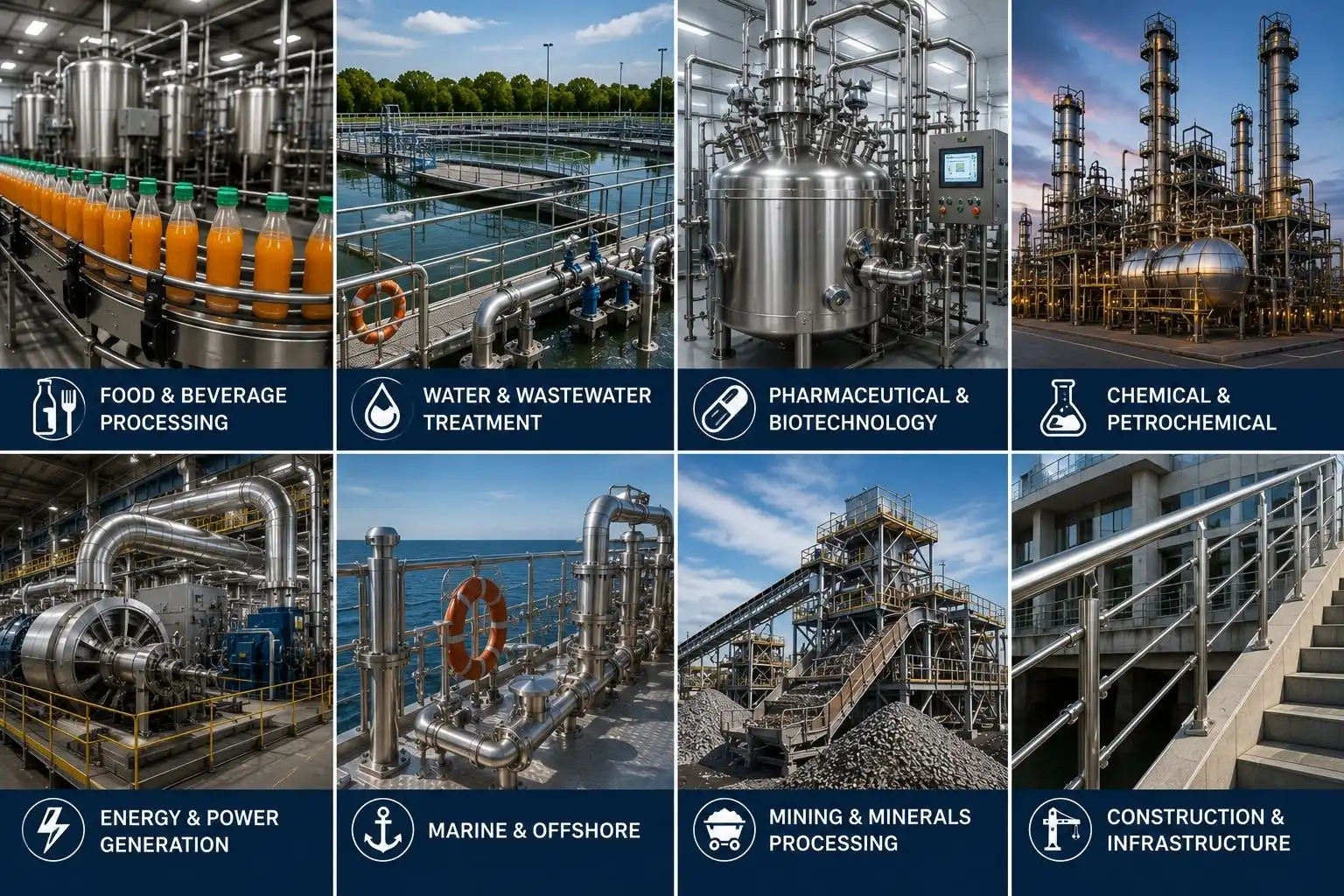
Almost every industrial sector uses stainless steel fabrication somewhere, but the reasons differ. Here is what each one specifies, how it is made, and which property is doing the work.
Food And Beverage Processing
Processing tanks and vessels, conveyor systems, pipework and valves, mixing equipment, storage silos and packaging machinery for the food processing industry as well as food and beverage processing. TIG welding is preferred for sanitary joints because heat control is precise and the weld can be finished cleanly, with electropolishing used where an ultra smooth surface is needed. Forming handles tanks and vessels, machining takes care of close tolerance components. Little of this work is standard, so much of it is manufactured to detailed customer specifications and lands with stainless fabrication shops rather than component suppliers.
A fabricated conveyor or packaging frame rarely arrives as a standalone item either. Drives, sensors, isolators and control panels have to be integrated alongside it, which is why fabrication and electrical support are usually scoped together on a production line.
The property being bought here is not just corrosion resistance but resistance to the cleaning regime. Food acids attack from one side and caustic wash down chemicals attack from the other, and a coated alternative fails against both. This is the highest volume application for stainless steel fabrication services in UK manufacturing, and the sector where industrial stainless steel fabrication is most often specified from scratch because it often demands the highest quality, with hygiene and audit performance directly affecting customer satisfaction.
Water And Wastewater Treatment
Treatment tanks, filtration systems, pipe networks, pumps and valves, aeration plant and disinfection equipment. Work tends toward large scale tank fabrication and pipe welding, with grade selection driven by the specific chemical exposure on site.
Chlorine and chloride exposure is the deciding factor, and it is where grade choice stops being academic. Components sit permanently wet or in splash zones, often with poor access once installed, so service life matters more than it would elsewhere. Industrial stainless steel fabrication earns its place here purely on how long the asset lasts before anyone has to go back to it.
Pharmaceutical And Biotechnology
Reaction vessels and fermenters, sterile pipework, cleanroom equipment, filtration housings, storage tanks and process skids. Welding standards are the highest of any sector, with full penetration TIG and orbital welding used for consistency, followed by electropolishing to a specified surface finish.
What separates this work is documentation. Material certification, weld records and process traceability are part of the deliverable, not an add on, because the installation has to be validated. Stainless steel fabricators working in this sector are effectively selling an audit trail alongside the component, and stainless steel fabrication services in this sector carry a documentation burden that rivals the metalwork itself.
Chemical And Petrochemical
Reactors and pressure vessels, heat exchangers, distillation columns, pipework, storage tanks and valve components. Heavy plate work, coded welding procedures, non destructive testing, and stress relieving or solution annealing where the application demands it.
Chemical resistance, pressure rating and temperature capability all matter simultaneously, which is what pushes this sector toward higher grades and duplex. Pressure equipment work in the UK falls under the Pressure Equipment Regulations rather than ASME, so verify which code a supplier actually works to before assuming equivalence.
Energy And Power Generation
Boiler tubes, turbine components, heat exchangers, geothermal plant and solar frame structures, plus components for the oil and gas industry. Coded welding for pressure equipment, precision machining, and quality control documentation throughout.
High temperature strength is the differentiator, alongside reliability in service where access for repair is limited or the plant cannot easily be taken offline. Specific grades are selected for nuclear applications where radiation resistance is a requirement, and industrial stainless steel fabrication for this sector carries qualification requirements few workshops hold.
Marine And Offshore
Fittings and hardware, propeller shafts, seawater pipework, desalination plant and platform components. Grade selection carries more weight than fabrication method, with 316, duplex or copper nickel specified according to exposure, and crevice corrosion designed out at the detailing stage rather than managed afterwards.
Seawater is the most aggressive routine environment stainless fabrication deals with, which is why specification errors show up quickly and expensively.
Engineer It Right First Time
If you take one thing away, make it this: ask your supplier to state in writing which grade they are specifying and why, before you compare anything else. Two proposals for the same drawing can read almost identically while one is built in 304 and the other in 316, and those components behave very differently in service. Comparing stainless steel fabricators UK-wide without that line on the page hides the difference entirely.
Singleton Engineering Solutions is a company that has manufactured from Burnley since 2015, working closely with clients and customers across many industries, delivering a specialist service from design through delivery to food producers, packaging plants, water treatment sites and distribution operators. If you are planning a project and want a stainless steel fabrication UK partner who will engineer it properly, built on practical knowledge, proven expertise, and a reputation for reliable work, rather than simply supply it, our fabrication service covers design, cutting, welding and installation of bespoke steelwork and machinery, manufactured to the highest standards and to customer specifications. Speak to our engineers on 01282 423198.
Frequently Asked Questions for Stainless Steel Fabrication
Can stainless steel fabrication services include design and installation?
Most projects run more smoothly when one firm carries the job from drawing to commissioning. Stainless steel fabrication services delivered alongside design and on-site installation remove the handover points where responsibility usually slips, and they mean the team cutting the material has seen the environment it will sit in. Singleton handles design, fabrication, installation and ongoing maintenance in-house, so a single point of contact covers the whole programme.
How do you choose between stainless steel fabricators UK wide?
Start with capability. Check whether cutting, welding, design and installation are handled in-house or subcontracted, because split responsibility tends to slow projects and blur accountability. Ask about welding qualifications, experience in your sector, and how the workshop handles finishing. Among stainless steel fabricators UK-wide, the most useful differentiator is whether a firm will challenge your specification when something simpler or cheaper would perform just as well.
Can bespoke stainless steel fabrication be fitted to an existing production line?
Retrofitting is common, and it is often the reason bespoke stainless steel fabrication gets specified in the first place. Off-the-shelf parts rarely match the dimensions, fixing points or clearances of plant already installed. The process usually begins with a site survey and measurement, then design, fabrication and an installation slot planned around production. Access, lifting routes and shutdown windows are worth agreeing early, as they frequently drive the programme.
How quickly can industrial stainless steel fabrication be delivered and installed?
Lead time depends on design complexity, availability of the specified grade, and how efficiently the workshop can schedule manufacture and finishing before delivery, as well as workshop capacity when the order is placed. Straightforward frames and guards move quickly, while industrial stainless steel fabrication involving multiple assemblies, detailed design or site installation takes longer. Most delays originate in incomplete briefs rather than in the workshop, so confirming drawings, grade, finish and tolerances up front shortens the programme. Installation is normally scheduled around planned downtime.