


A single electrical fault on a production line can halt output within minutes, and the bill for that downtime climbs fast once lost orders, overtime repairs, and compliance risk are added up. According to official UK government fire statistics, electrical distribution was the single largest specified source of ignition for fires in commercial and industrial buildings, accounting for 16% of other building fires, excluding other and unspecified causes.
Unlike collision damage or weather-related outages, faulty wiring, overloaded circuits, and ageing distribution boards build up quietly behind panels and ceiling voids for months before they fail, which means the risk is often invisible until the site is already dealing with a shutdown, an insurance claim, or worse. That raises an obvious question: what actually separates a site that catches these faults early from one that doesn’t?
What do Industrial Electrical Services Cover
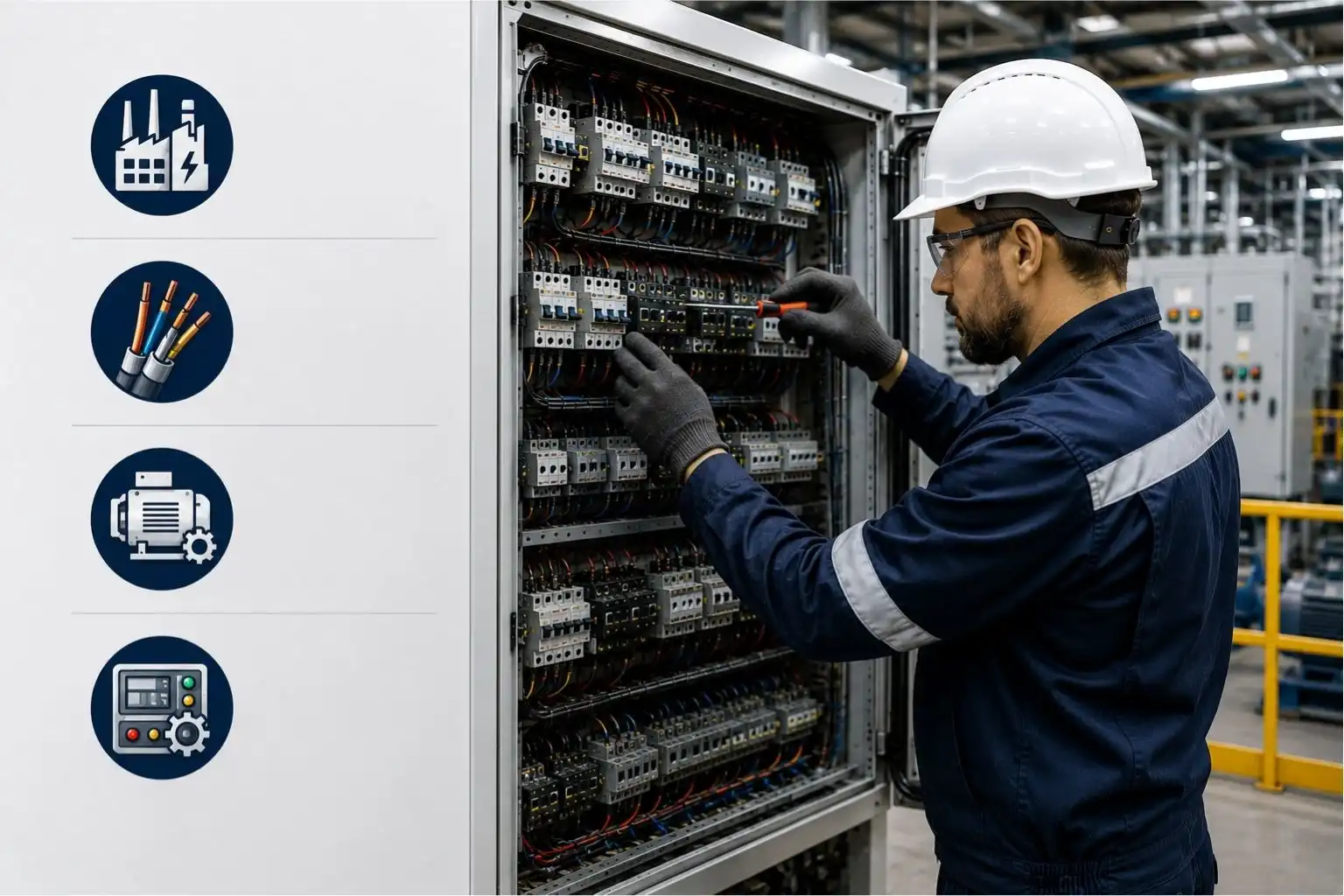
Industrial electrical work spans several systems, from power distribution down to individual machine wiring, all working together to keep a site running safely and without interruption.
Factory Electrical Systems
A factory’s electrical system carries the full weight of its operations, feeding power to production lines, machinery, lighting, and safety systems alike. Reliable industrial electrical installation at this level delivers:
- Continuous power supply that keeps costly downtime off the table
- Distribution designed to cut unnecessary energy loss
- Protective devices, including circuit breakers and surge protectors, that respond the moment a fault occurs
Industrial electrical contractors rarely design these setups alone, working alongside engineers and building in redundant circuits so a single failure doesn’t take the whole system down with it. For sites that need custom brackets, enclosures, or structural steelwork built around their electrical infrastructure, our Fabrication & Manufacturing service handles design through to delivery under one roof.
Industrial Wiring and Cabling
Industrial electrical wiring has to hold up to conditions residential systems were never built for, from higher voltage loads to constant heat and mechanical wear. Done properly, industrial wiring provides:
- Safe power distribution across machinery and workstations
- Reliable support for automated systems, heavy equipment, and HVAC units
- Durability against heat, moisture, and ongoing mechanical stress
An industrial electrical engineer selects specialised cabling and structured layouts built for long-term use, keeping the whole system compliant with current electrical standards. For sites looking to catch wear and faults before they cause a failure, our Maintenance & Inspection service keeps wiring and cabling performing as intended long after installation.
Machinery and Equipment Installation
Getting heavy machinery running safely takes more than a straightforward power connection. Industrial electrical services at this stage cover:
- Powering and connecting large-scale equipment
- Syncing electrical systems with existing automated processes
- Building in safety mechanisms before the machine goes live
Getting installation right cuts the risk of machine failure and delayed production, keeping the factory floor running as intended. This work tends to run alongside wider Mechanical Engineering support, since installing new machinery is rarely a purely electrical task on a live site.
Control Systems and Automation
Automation now underpins most modern factory operations, and it depends entirely on the electrical infrastructure behind it. Commercial and industrial electrical services support:
- Programmable Logic Controllers (PLCs) for process control
- SCADA systems for monitoring and data collection
- Electrical integration for robotic machinery and automated equipment, including systems used in Laser Profiling work
Maintaining and programming these systems is where industrial electrical contractors add the most value, helping factories streamline operations, boost productivity, and cut down on human error across the shop floor.
What are the Benefits of Industrial Electrical Services
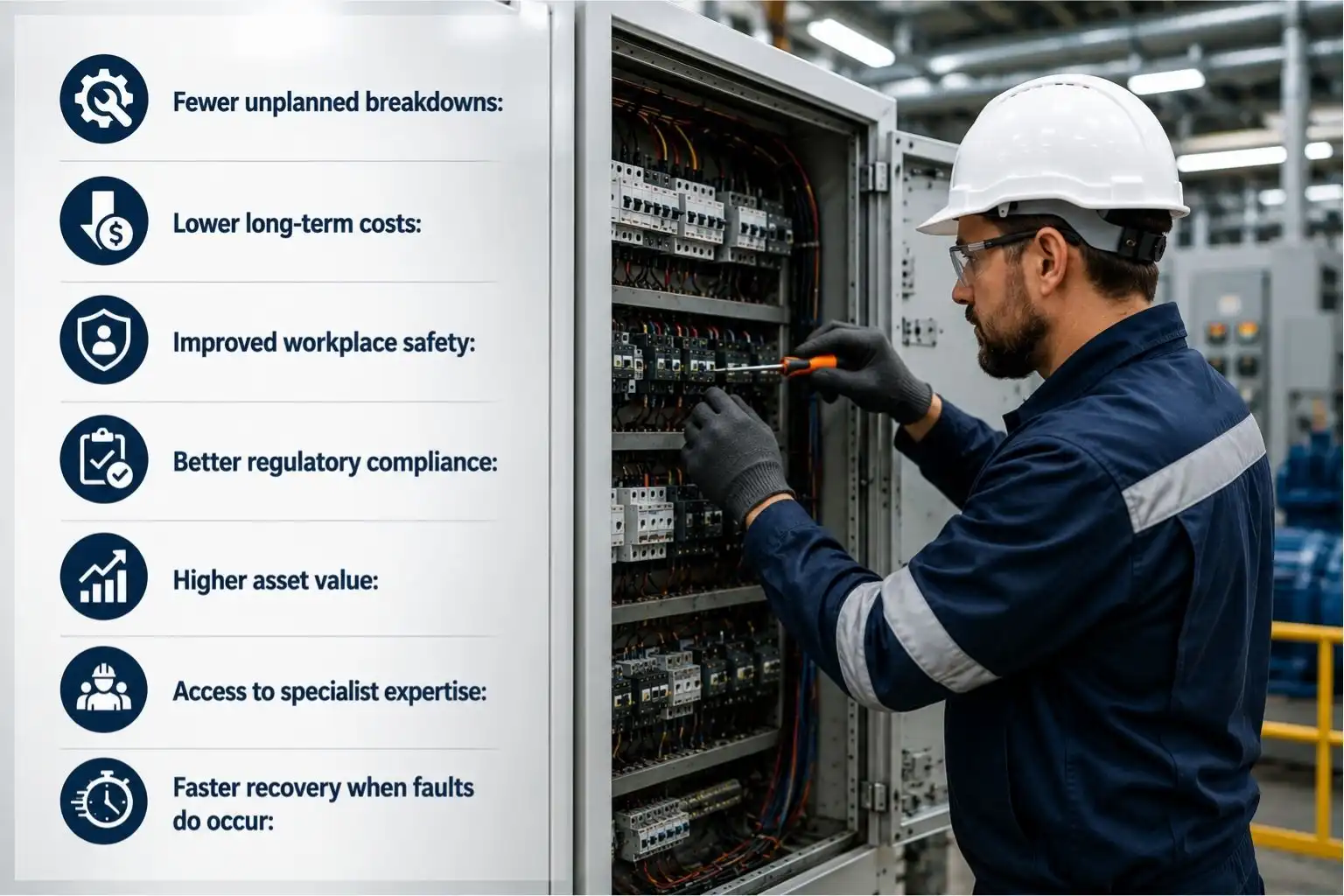
Investing in professional industrial electrical services delivers returns well beyond a single repair job. The main benefits include:
- Fewer unplanned breakdowns: scheduled inspection and predictive maintenance catch faults before they cause a stoppage, reducing reliance on emergency callouts.
- Lower long-term costs: preventive work and early fault detection are consistently cheaper than emergency repairs or full system replacement, and energy-efficient upgrades cut ongoing utility bills.
- Improved workplace safety: correct lockout/tagout procedure, protective device testing, and adherence to standards such as NFPA 70E reduce the risk of shock, arc-flash, and fire hazards.
- Better regulatory compliance: qualified industrial electrical contractors keep systems aligned with current national and local electrical codes, avoiding penalties tied to non-compliance.
- Higher asset value: well-documented, modern electrical infrastructure supports easier upgrades and stronger resale value over time.
- Access to specialist expertise: a qualified industrial electrical engineer brings licensing, insurance, and hands-on experience with high-voltage systems and automation controls that general electricians are not trained to handle.
- Faster recovery when faults do occur: 24/7 emergency response from experienced industrial electrical contractors limits how long a line stays down and how much a fault ends up costing.
Together, these benefits are why sites relying on commercial and industrial electrical services on a contracted, ongoing basis consistently outperform those treating electrical work as a one-off fix.
Industrial vs Commercial Electrical Services: What’s the Difference
The table below sets out how the two compare for a site relying on commercial and industrial electrical services.
| Area | Industrial Electrical | Commercial Electrical Services |
|---|---|---|
| Typical sites | Factories, production lines, distribution centres | Offices, retail units, lighter premises |
| Load demands | Heavy, three-phase, high-voltage | Modest |
| Downtime impact | Can halt an entire production line | Costly but contained |
| Common work | Motor control centres, automation integration, load balancing | General wiring, lighting, fit-outs |
A provider offering both commercial electrical services and specialist industrial cover gives a site genuine flexibility as its operations grow, letting one contractor scale support from a single office fit-out to a full production facility without switching suppliers.
How to Choose the Right Industrial Electrical Contractors
Start with certification, since industrial and high-voltage work requires qualifications beyond standard electrical training, especially for three-phase systems and automation controls. Check insurance cover and ask for a compliance track record, as both indicate how seriously a contractor treats safety and regulation.
Look for relevant site experience too. A contractor who has worked on similar facilities, be that’s a factory floor or distribution centre, will spot risks a generalist might overlook and resolve faults faster. Ask about response times for emergencies, since faults rarely happen during convenient hours.
Finally, favour contractors offering ongoing inspection and maintenance plans over one-off callouts, and request a written quote breaking down labour, materials, and support costs before committing.
Invest in Reliable Industrial Electrical Support
Now that you understand what separates a reliable industrial electrical contractor from a general one, the next step is matching that standard to the provider you actually choose. That keeps downtime under control, protects staff and equipment, and helps sites land on a contractor who genuinely fits the demands of their operation.
At Singleton Engineering, we have built our reputation over many years by helping customers keep their industrial electrical systems safe, compliant, and running without interruption. We combine specialist electrical expertise with full site experience, handling installation, maintenance, inspection, and emergency response as part of end-to-end support for the best possible outcome.
View our Electrical Support service to keep your factory systems, machinery, and control infrastructure performing reliably for years to come. Contact us at office@singletonengineering.co.uk or 01282 423198 to discuss your project requirements today.
Frequently Asked Questions About Industrial Electrical Services
How do I get a quote for industrial electrical services?
Getting an accurate quote starts with a site visit rather than a phone estimate, since pricing depends on the size of the facility, the condition of existing equipment, and the scope of work required. An industrial electrical engineer assesses the site directly, checking panels, wiring, and machinery before putting together a detailed quote that reflects what the job actually needs.
This also gives the contractor a chance to flag any compliance issues that might affect the final price. Sites looking to compare providers should ask for a written breakdown covering labour, materials, and any ongoing maintenance costs, rather than a single lump sum figure that’s harder to evaluate against other quotes.
How often should industrial electrical systems be inspected?
Inspection frequency depends on several factors, including the age of the equipment, how heavily it’s used, and the manufacturer’s own guidance, so there is no single fixed interval that suits every site. A qualified industrial electrical engineer will typically recommend a schedule based on the criticality of each asset and its failure history, rather than applying a blanket rule across the whole facility.
High-voltage systems and machinery running continuous shifts usually need more frequent checks than lightly used equipment. That schedule isn’t fixed once and forgotten either, it gets reviewed and adjusted as equipment ages, production demands shift, or new machinery gets added to the line, keeping inspection intervals aligned with actual site conditions.
Why do industrial sites need specialist electrical contractors rather than general electricians?
Industrial sites involve high-voltage equipment, automation integration, and heavy machinery that general electricians are not trained or certified to handle safely. Specialist industrial electrical contractors bring the licensing, insurance, and hands-on experience needed to work on these systems without exposing staff or equipment to unnecessary risk, reducing the likelihood of shock, arc-flash, and fire hazards on site.
They’re also familiar with standards general electricians rarely encounter, including motor control centres, three-phase load balancing, and lockout/tagout procedure specific to industrial machinery. That depth of experience matters most when a fault occurs mid-shift, since a contractor who already understands the site’s equipment can diagnose and resolve the issue far faster than one starting from scratch.
Can industrial electrical services help reduce energy costs?
Yes, energy efficiency upgrades are a core part of most industrial electrical services, and they typically pay for themselves over time through lower utility bills. LED retrofits, smart lighting controls, and load balancing all reduce ongoing electricity consumption without requiring a full system rebuild.
An industrial electrical engineer can assess where a site is losing energy unnecessarily, often in outdated lighting, imbalanced circuits, or ageing equipment running less efficiently than it should. These upgrades are frequently bundled into a wider maintenance visit, meaning a site can address safety, compliance, and energy costs in a single coordinated project rather than three separate ones.