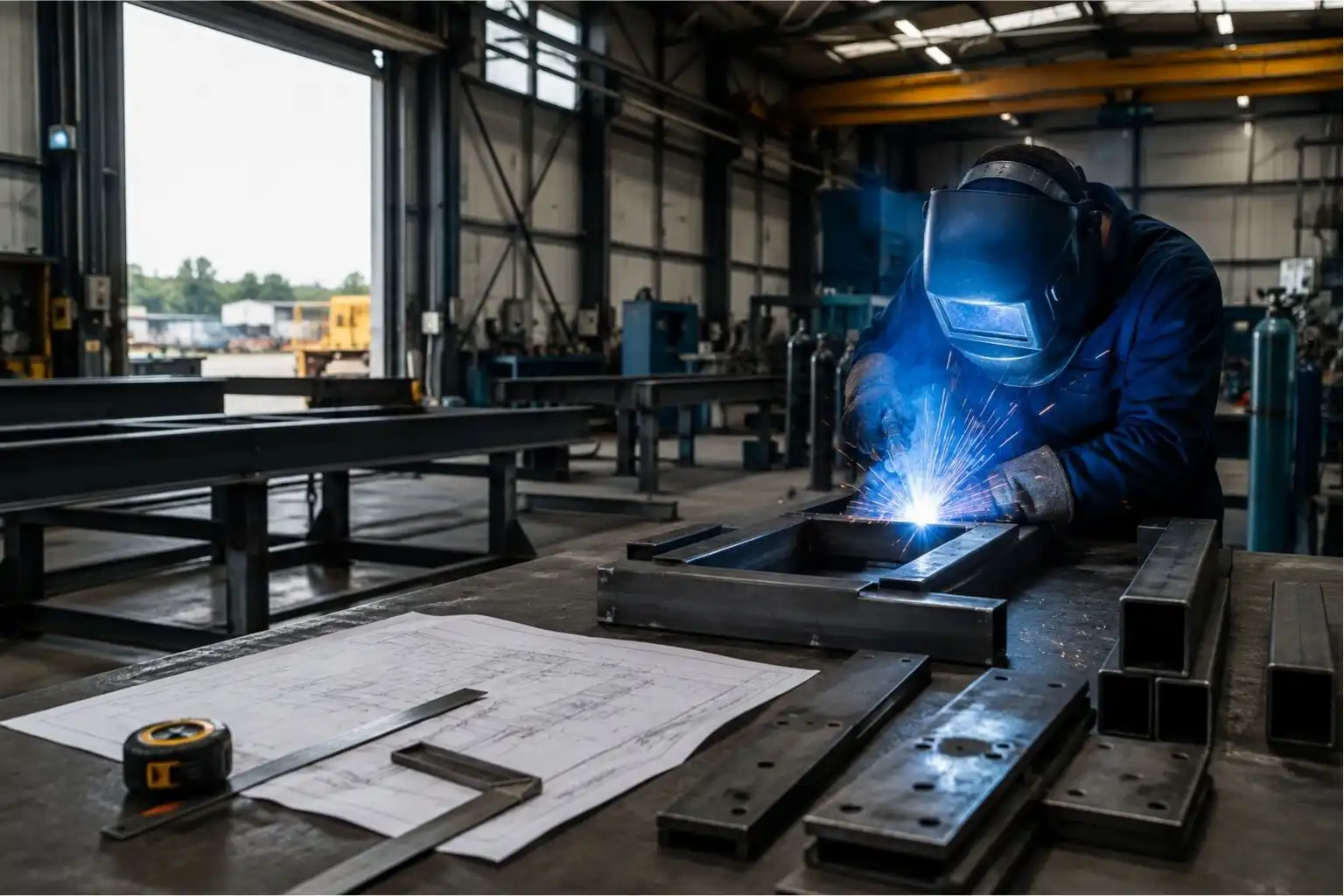
A fabricated access platform that will not fit through the door it was built for did not fail in the workshop. It failed months earlier, at the planning stage, when nobody measured the route in. Research from the Construction Industry Institute found that design changes, errors, and omissions accounted for 79% of the costs associated with quality deviations across nine industrial construction projects.
Industrial metal fabrication, the work of cutting, forming, joining and finishing raw metal into a finished structure or component, rewards early decisions and punishes late ones. So, what should be considered before a fabrication project moves from the drawing board to the workshop?
What is Sheet Metal Fabrication
Put simply, metal fabrication is the process of turning raw plate, sheet and section into a finished assembly. It spans structural steelwork, tanks, machine guarding, conveyor frames and precision sheet metalwork for enclosures and panels. Sheet metal fabrication covers thinner gauge material, cut on laser or punching machinery and formed on a press brake.
Heavier plate sits closer to custom steel fabrication, where load paths govern the build. Custom fabrication means anything made to a drawing, and architectural metal fabrication applies the same processes to staircases, balustrades and cladding. Every item begins as a requirement, not a product, which is why planning drives cost more than any later stage.
How to Plan an Industrial Metal Fabrication Project

Well-run projects follow a recognisable sequence, with each phase closing off decisions that become expensive to reverse later.
1. Define the Scope in Full
Nearly every avoidable delay traces back to an incomplete brief. State what the item does, where it sits, what it carries and what it is exposed to: duty (static load, dynamic load, pressure, containment or access), environment (internal, external, coastal, chemical exposure, washdown), quantity, and the interfaces it bolts to or replaces.
Constraints belong here too. Weight, footprint, transport envelope, door widths and lift dimensions all shape a custom fabrication design. A job scoped as one welded assembly often becomes a bolted modular build once access is checked. For a requirement that starts as a description rather than a drawing, our fabrication and manufacturing can work the scope through with you.
2. Select the Material Early
Grade selection balances corrosion resistance, weight, weldability, cost and availability, with stainless steel often chosen where hygiene and durability matter. Chemical or washdown exposure usually rules out coated mild steel over a long service life, while craneage limits push a design toward aluminium, and hygiene requirements point the same way toward stainless; for example, commercial kitchens often use stainless steel sheet metal for work surfaces.
Availability drives the programme as firmly as price does, and common fabrication materials include steel, aluminium and copper alloys. Non-standard sections and thicknesses add weeks to a lead time, so confirm stock with the supplier before the design is frozen rather than after approval, especially for specialist materials such as brass. Agreeing the grade early also settles the finishing route, since coating, galvanising and passivation each suit different materials and each carries its own booking window.
3. Design for Manufacture
Tolerances drive cost more than any other design decision, so specify only what the function requires. Tight tolerances add machining passes and inspection time. Machining is a subtractive manufacturing process used for high precision work. Architectural metal fabrication is the exception, as visible surfaces are judged by eye.
Bend radius follows material thickness and grade, and a radius that is too tight will crack metal sheets formed to the desired shape. Leave torch and hand access at every joint. Parts are tack welded before welding, and welds you cannot reach become rework. A stout fixture keeps parts stable. On larger runs, nesting cuts waste. A sheet metal fabrication project may involve machined parts, and for repeat work our general manufacturing holds the drawings and the tooling.
4. Choose the Processes
Cutting method follows thickness, edge quality and heat sensitivity. For thinner plate and repeat components in sheet metal fabrication, our laser profiling service uses laser cutting for precision, while cutting torches suit large sections and thicker material. Forming runs through press brakes, rolling or cnc folding depending on geometry, with cnc machinery bending sheet metal to the desired shape on consistent bend allowances.
Joining covers MIG (metal inert gas), TIG (tungsten inert gas), spot welding, bolting and riveting, fabrication methods and welding techniques selected on material, thickness, strength, appearance and serviceability. Finishing settles appearance: powder coating, galvanising, wet paint, passivation and anodising each carry their own lead time, and several are batch-scheduled by an external supplier rather than controlled in house.
5. Appoint the Right Fabricator
Capability and capacity are separate questions. A workshop may hold exactly the right machinery for your custom metal fabrication work and still have no slot in the schedule for six weeks, so ask whether the team can meet exacting requirements for customers before you shortlist. Check accreditations against the duty involved, including BS EN 1090 execution class for structural work and ISO 9001:2015, a recognised quality management standard.
Also look for CHAS accreditation to support health and safety compliance, plus current welder qualifications for the joints in your drawings. Robust quality standards relied on by over 85,000 engineers matter here. Industrial metal fabricators that finish in house give you shorter lead times and one point of accountability. If a job needs surveying, installing and commissioning as well as building, our mechanical engineering closes the handover gap.
6. Build the Budget and the Programme
Custom steel fabrication cost falls into six buckets: material, labour, tooling and setup, finishing, transport and installation. Setup is fixed per run, so unit cost drops as batch size rises, and splitting one requirement into two separate orders costs more than placing it once.
Four things reliably push a quote up: tolerances tighter than the function needs, specialist grades, multi-stage finishes, and late design changes after cutting. Hold a contingency for design development, with ten per cent a common starting point on custom fabrication work. Approval cycles are the leading cause of slippage on industrial metal fabrication projects, so give them real dates.
7. Plan Quality, Delivery and Installation
Agree an inspection and test plan before production starts, with hold points named: dimensional checks against approved drawings, first article inspection on batch work, weld inspection appropriate to the duty, EN 10204 3.1 traceability, and coating thickness and adhesion.
Delivery needs its own plan: lifting arrangements, access routes, craneage, transit protection for coated and stainless finishes, and sequencing against other trades on site. For powered assemblies and control panels, our electrical support should be booked into the same programme rather than chased afterwards. Close with a handover pack, then set the servicing intervals from day one.
Which Material Suits Your Fabrication Project
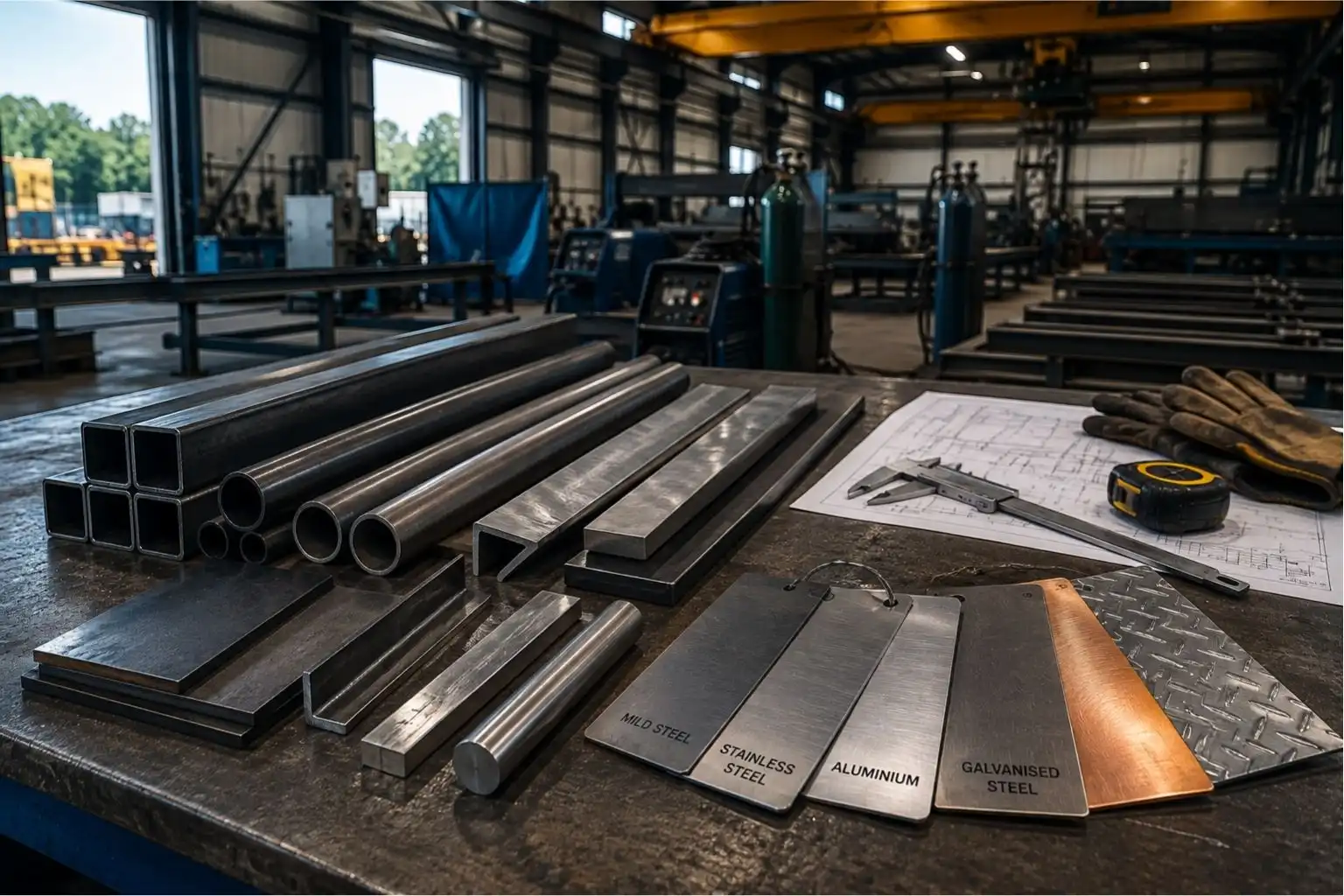
Grade sets the tone for the whole build, from weld distortion on stainless sheet metalwork to the touch-up needed where galvanised steel has been welded:
| Material | Strengths | Watch points |
|---|---|---|
| Mild steel | Low cost, easy to weld, widely available | Corrodes without coating, heavier |
| Stainless | Corrosion resistance, hygienic, no coating needed | Higher cost, distortion when welding |
| Aluminium | Light, corrosion resistant, good strength to weight | Softer, specialist welding, higher material cost |
| Galvanised | Protected, long service life outdoors | Coating damaged by welding, needs touch-up |
Experienced industrial metal fabricators will challenge a grade specified out of habit rather than duty. On custom steel fabrication and architectural metal fabrication alike, that conversation takes cost out of a job without changing performance.
Which Industries Benefit From Industrial Metal Fabrication
Some operations have more riding on a fabrication project than others, and metal fabrication is crucial across construction, automotive, aerospace and energy as well as the sectors listed below:
- Food processing and production: stainless conveyor frames, guarding and hygienic enclosures for commercial kitchens and other professional environments, where a planned custom metal fabrication package avoids a multi-day halt at peak.
- Water treatment sites: access platforms, walkways and tank work in aggressive conditions, where grade and finish decisions govern compliance and service life.
- Distribution centres: conveyor supports and mezzanine steelwork, with similar sheet metal applications used in retail display units and product showcases, where custom steel fabrication planned around shift patterns beats an emergency replacement.
- Construction and refurbishment projects: architectural metal fabrication for staircases, balustrades and cladding, where visible finish quality and site protection sit alongside structural duty.
- Manufacturers with ageing plant: bespoke guarding and replacement parts in sheet metal fabrication, since obsolete equipment rarely has an off-the-shelf answer.
Across all of them the pattern repeats. Custom fabrication planned properly is quoted accurately, built once and installed on time. Work rushed into the workshop pays twice.
Start Your Industrial Metal Fabrication Project Right
Every fabrication project is decided long before anyone cuts metal. Scope, grade, tolerance and access route are the four decisions that set your final cost, and getting them written down early is what separates a job quoted accurately from one repriced twice. Put the brief in front of a fabricator while the design can still change, and the awkward questions cost nothing to answer.
At Singleton Engineering, our engineers take that conversation from a sketch or a site measurement through to a costed programme, covering material choice, custom metal fabrication, finishing and installation on the same drawing pack. See our Fabrication & Manufacturing services for the full picture of what we build in house. Contact us at office@singletonengineering.co.uk or 01282 423198 to talk through your requirement before the specification is locked.
Frequently Asked Questions About Industrial Metal Fabrication
How long does a metal fabrication project take?
Our lead times depend on design approval, material availability, workshop loading and finishing, so we cannot quote a standard duration. Bespoke work usually spends longer in design and approval with us than it does in our workshop, and external processes such as hot dip galvanising or passivation are batch-scheduled, which puts them on the critical path of the programme we build for you.
The reliable way to shorten that programme is to close out our design queries quickly and let us confirm stock before we freeze the drawings. We give you an indicative programme at quotation and flag anything likely to extend it, so the date you get reflects the real sequence.
What information do you need before quoting?
We need, at minimum, dimensioned drawings or a 3D model, material grade, quantity, finish requirement, tolerances and the delivery location. Weld symbols, a parts list and any applicable standard, such as BS EN 1090 execution class, save us another round of questions. For sheet metalwork, tell us the gauge and bend detail early, because both change how we price and plan the work.
Where drawings do not yet exist, a description of duty, environment and interfaces is enough for us to start. We regularly develop sketches and our own site measurements into a full drawing pack, so an incomplete brief is no barrier to getting a price.
Can you match or replace a part from obsolete equipment?
Usually, yes. Obsolete machinery is one of the more common reasons manufacturers come to us, because the original supplier has gone or the part is no longer catalogued anywhere. We reverse engineer from the worn component, take our own measurements directly from the machine where the part has failed completely, and produce a drawing for your approval before we begin manufacture.
We match material grade to the original duty rather than copying it blindly, since the first part sometimes failed because the grade was wrong for the job in the first place. Send us photographs and the machine details, and we will confirm what is feasible before you commit.
Can you work from a sketch or a sample part if we have no drawings?
Yes. A hand sketch, a photograph with dimensions, or the broken part itself is enough for us to start, and it is how a fair share of our custom fabrication enquiries arrive. We measure the sample or the location ourselves, then produce a drawing pack for you to approve before we cut anything, so you see exactly what we will build.
That approval step matters to us, because a sketch leaves room for interpretation and a dimensioned drawing does not. Send us what you have with a note on duty, environment, finish and quantity, and we will tell you what else we need to price it.