
Confusing fabricated steel with welded assemblies can lead to incorrect specifications, unexpected production costs and delays on your project. The distinction matters because the way steel components are cut, shaped and joined directly affects how a structure is manufactured and performs.
According to a study published in the Journal of Constructional Steel Research, welding can account for up to 30% of the total fabrication cost of steel structures, highlighting the financial impact of joining methods on steel manufacturing.
So if fabrication methods and welding requirements can significantly affect project costs, what actually separates fabricated steel from welded assemblies, and how does each approach influence the final product?
What is Fabricated Steel?
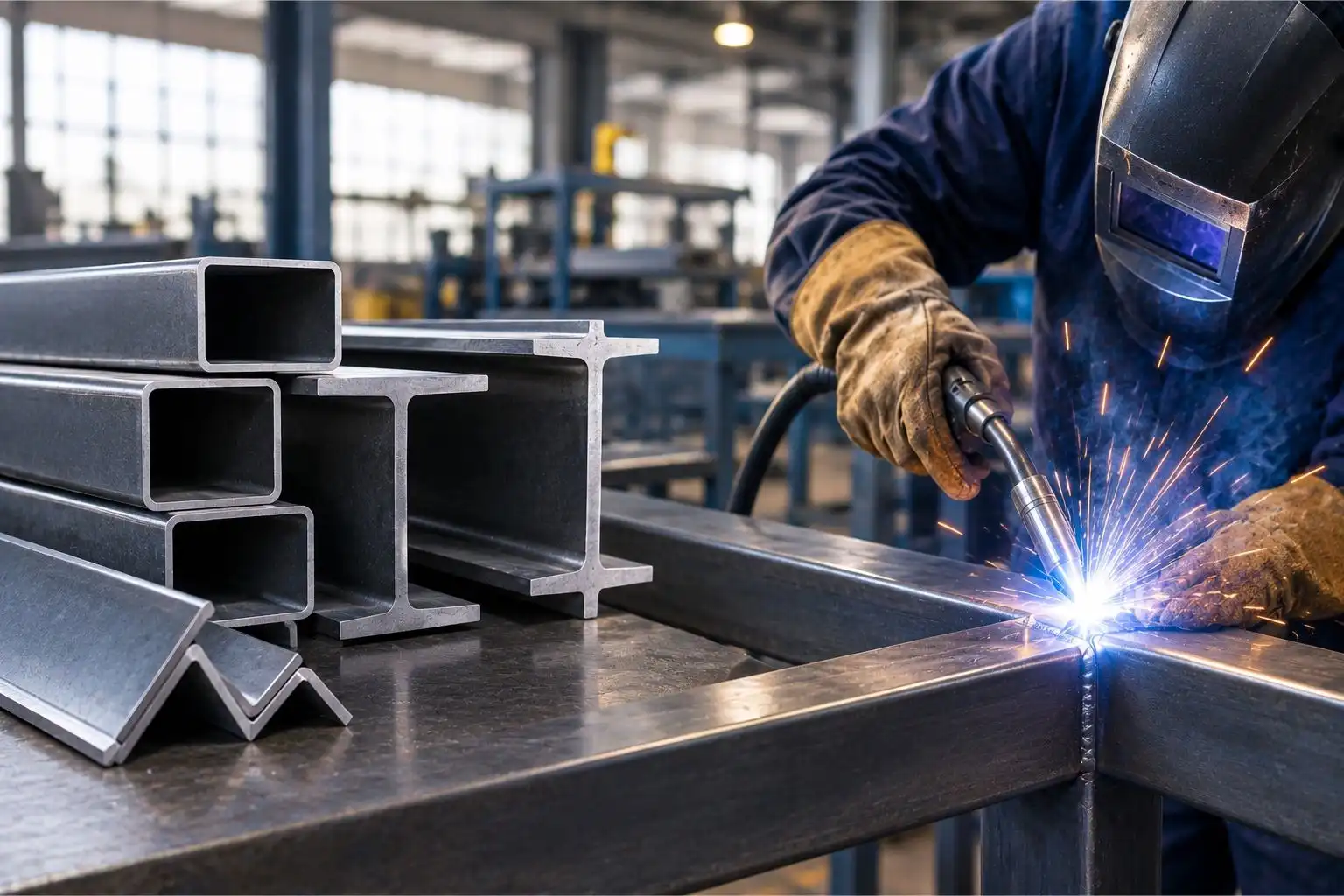
Fabricated steel is steel produced through the steel fabrication process, where components are made to precise measurements from drawings and then cut, shaped and assembled into a finished part or structure. It starts life as standard stock such as plate, section, tube or bar, and fabrication turns that raw material into something with a specific job, from a bracket to a machine frame; in construction, structural steel is commonly used to create steel beams and columns.
A component counts as steel fabricated once it has passed through these stages, however its pieces are held together. When a part is designed for one application, the work is known as custom steel fabrication. Design flexibility in the fabrication process allows custom or desired shapes before cutting begins. Typical fabrication stages include:
- Cutting and profiling plate and section to size, often by laser for clean, repeatable edges
- Forming, bending, drilling and punching parts ready for assembly
- Joining by welding, bolting, riveting or adhesive bonding, then finishing with grinding, blasting, painting or other surface treatment
Because joining is only one stage, plenty of fabricated steel products contain no welds at all. Bolted access platforms, modular racking and site-assembled stairs are all fabricated steel, as is a welded machine base. Good custom steel fabrication starts with a clear definition on the drawing.
What is a Welded Assembly in Steel Fabrication?
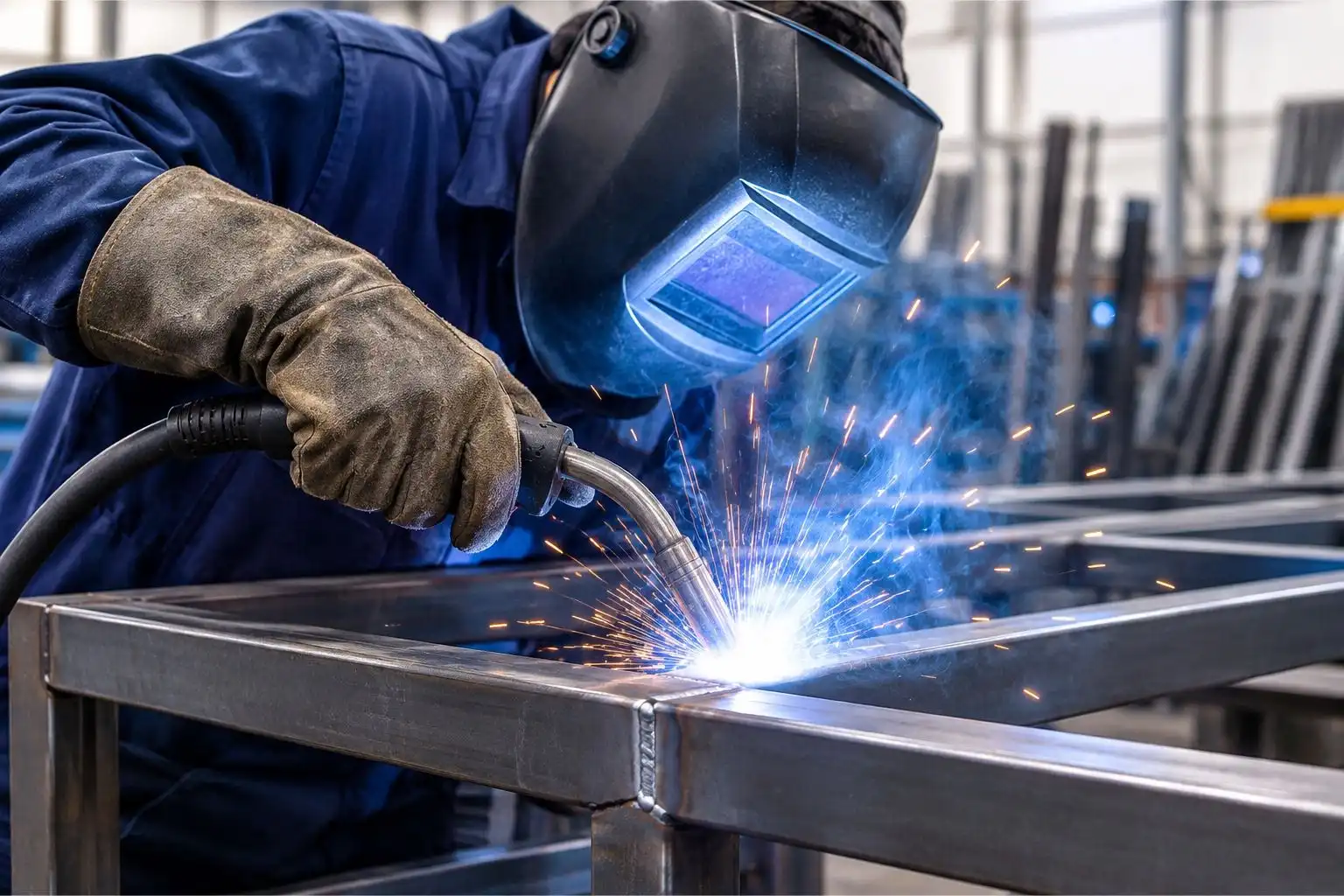
Here, the parts are fused into one permanent unit. A welded assembly, known in engineering terms as a weldment, is defined in the American Welding Society’s terminology standard, AWS A3.0, simply as an assembly joined by welding, where steel components are joined using an electric arc to generate heat. Common techniques include MIG, TIG, and stick welding. Common welded assemblies include:
- Machine bases and production line frames that need one rigid, stable structure
- Tanks, hoppers, chutes and ducts where seams must be sealed against leaks
- Stainless conveyor frames for washdown areas, with continuous welds ground smooth for cleaning
Welding asks more of a project than bolting. Each joint creates a heat-affected zone with residual stress and possible distortion, so procedure, fit-up and heat input all matter. On stainless steel fabrication, stainless steel combines high tensile strength with corrosion resistance, but careful heat control still protects corrosion resistance next to the weld.
Structural work is commonly fabricated to BS EN 1090, with welders qualified to BS EN ISO 9606, and structural steel fabrication also supports safety-critical oil and gas infrastructure, where ensuring structural integrity matters. It also pays to ask any supplier which standards apply to your job, especially where load paths and structural integrity are critical.
Critical welds may also need non-destructive testing such as ultrasonic or magnetic particle inspection. Labour is the other pressure point. Coded welders take years to train, and with fewer people entering the trade, welding hours make up a growing share of the cost of many fabricated steel products.
Fabricated vs Welded Steel: Which Suits Your Project?
Here’s how fabricated steel and welded assemblies compare across scope, strength, cost, transport and repair; fabricated steel is often chosen for its high strength-to-weight ratio.
| Factor | Fabricated Steel (broad) | Welded Steel |
|---|---|---|
| Scope | Full process: cut, form, drill, join, finish | The result of one joining method |
| Joining | Welding, bolting, riveting or adhesives | Welding only |
| Permanence | Permanent or demountable | Permanent, removal means cutting |
| Joint strength | Bolted joints limited by bolts and holes | Continuous material, usually higher capacity |
| Material cost | Bolts, washers, plates and holes add cost | Fewer fasteners and connection plates |
| Labour | Fitters and erectors | Qualified, coded welders |
| Transport | Can travel in sections | Limited by what fits on a lorry |
| Repair | Unbolt, swap or adjust | Re-weld and often re-inspect |
Steel also offers high strength at relatively low weight, which is why steel elements are common in bridges and infrastructure where high tensile strength is needed.
A common myth says welded parts are weaker than other steel fabricated joints. A properly made weld usually gives higher joint capacity than bolting, and poor procedure, not welding, is what weakens it. Clean profiles from laser profiling give tight fit-up for welded assemblies and consistent holes for bolting, reducing rework as steel fabrication services move from cutting to assembly. Fabricated steel components can speed construction because fabricated components arrive ready for assembling.
In food and washdown areas, stainless steel fabrication adds hygiene to the decision. Continuous, crevice-free welds leave nowhere for residue to collect. Grade 304 suits general washdown, while 316 resists chlorides and harsher chemicals. Across custom steel fabrication and fabricated steel products, Singleton’s maintenance and inspection engineers see poorly finished joints surface first as cleaning problems.
How Do You Choose the Right Option for Your Project?
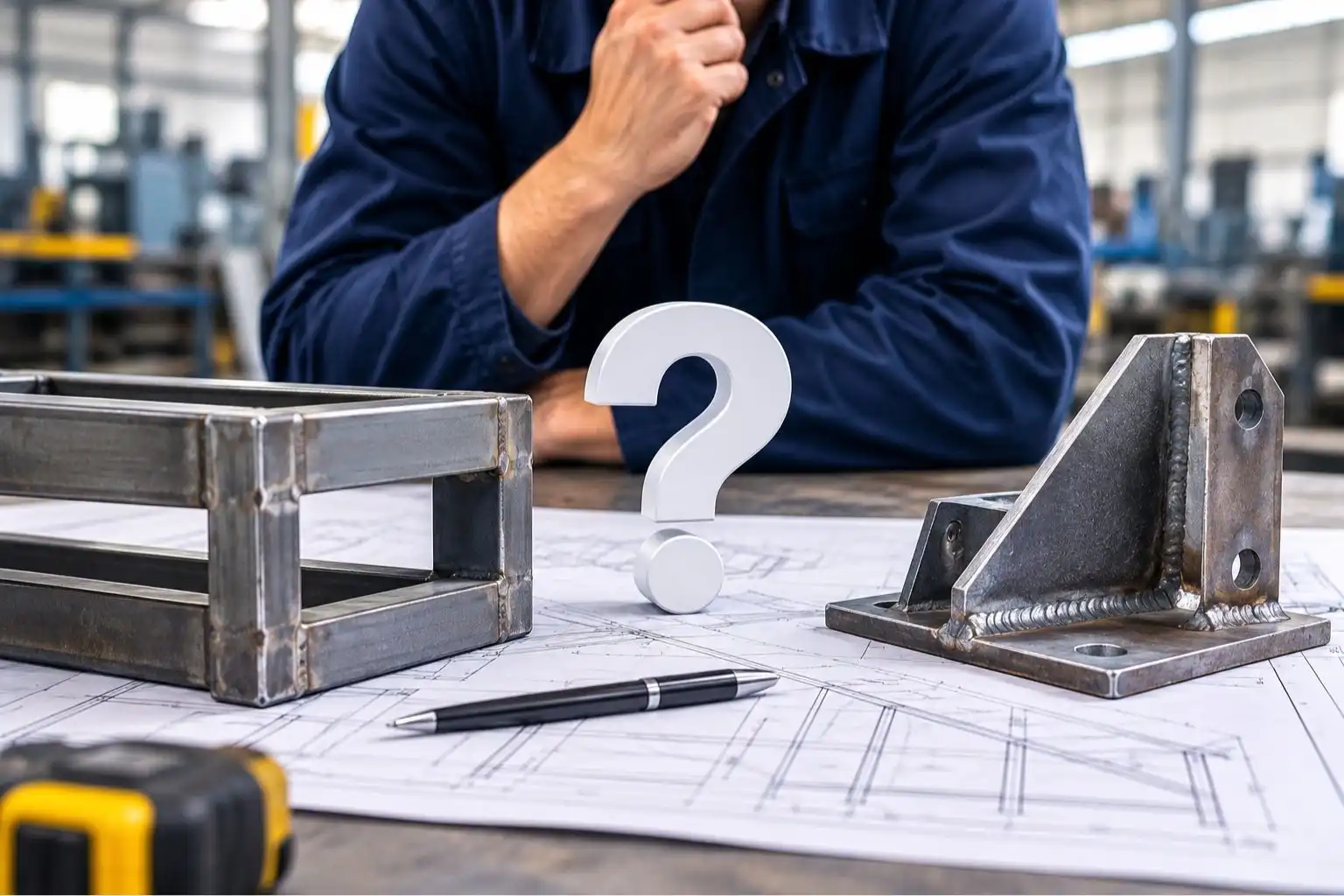
Picking between the two comes down to matching each joining method to the job a part has to do. A single project often needs both, and the best results come from deciding joint by joint. Work through these steps part by part:
- Define the load and rigidity needed: Frames carrying heavy or vibrating machinery usually benefit from a welded assembly, where the material path is continuous. In many construction projects, steel can span long distances without interior support columns, which also supports open-plan and flexible floor designs.
- Check how the part will travel: If the finished item will not fit on a lorry or through a factory door, bolted sections make delivery and installation far easier.
- Look at the operating environment: Sealed seams for tanks and hoppers, or hygienic surfaces for food lines, point towards continuous welds.
- Plan for future changes: Layouts that shift every few years suit bolted guarding and platforms steel fabricated for quick removal and refitting.
- Count the site restrictions: Hot works permits, live production and short shutdown windows all favour work finished in the workshop and bolted on site. Off-site work with precision engineering can also reduce waste during the construction process.
- Ask suppliers to state their joining method: When comparing steel fabrication services, request a clear note of which joints are welded, which are bolted and why, so quotes are compared on equal terms. A capable structural steel fabricator should also interpret designs accurately before work starts.
Take a typical food production upgrade. A producer replacing an ageing conveyor needs a stainless frame that survives daily washdowns, and an access platform so operators can reach it safely. The conveyor frame is steel fabricated as a fully welded unit in the workshop, with every joint ground smooth. The platform is built as bolted sections, pre-assembled and checked, then fitted during a planned weekend shutdown.
This split keeps hot works away from the live production area. For joining decisions settled before any metal is cut, our mechanical engineering team uses detailed CAD software, where the process begins before fabrication, and designs in 3D CAD so every welded and bolted joint is visible and signed off early. For lines built around daily washdowns, our food processing and production machinery follows the same joint-by-joint thinking for UK food producers.
Plan Your Next Fabrication Project With Singleton
Welding and bolting each earn their place, and the strongest projects use both where they suit. Welds belong where strength, sealing or hygiene count, while bolts serve parts that need to travel, stay accessible or change later. Keeping welding in the workshop and bolting on site gives tighter control over quality and keeps hot works and downtime low, so welded assemblies arrive ready to fit, not ready to fix.
Singleton Engineering Solutions has supported manufacturers and food producers from Burnley, Lancashire since 2015. Our custom steel fabrication covers welded, bolted and hybrid builds, from one-off parts to fabricated steel products made to your drawings, with steel fabrication services running from laser cutting to on-site installation. Call 01282 423198, email office@singletonengineering.co.uk , or get a quote.
Frequently Asked Questions About Fabricated Steel
Can steel be fabricated without welding?
Plenty of steel is fabricated without welding at all. Parts can be cut, bent and drilled, then joined with bolts, rivets or structural adhesives. Pre-engineered buildings, modular racking, demountable platforms and many staircases are built this way, so they can be delivered flat and assembled or relocated on site.
Skipping the welds avoids heat distortion and hot works permits, which helps where work takes place in live production areas. It also allows galvanised or painted parts to be finished before assembly without damage from welding heat. The trade-off is cost, as fasteners, connection plates and accurately drilled holes add material and machining time to each joint.
Do welded assemblies need inspection or certification?
Inspection requirements for welded assemblies depend on what the part does and where it is used. Every weld should be visually checked for defects such as cracks, porosity and undercut. Load-bearing or safety-critical welds may also need non-destructive testing, including ultrasonic, magnetic particle or dye penetrant checks. Welders should hold current qualifications for the processes and positions they use.
Structural steelwork placed on the UK market is generally covered by BS EN 1090, with its own factory production control, certification and UKCA or CE marking requirements. Pressure equipment and food-contact parts can bring further standards. Your engineer or supplier should confirm which standards apply before work starts.
Do you take on one-off parts and small batch work?
Yes. Our custom steel fabrication covers everything from single replacement parts to complete machinery frames and repeat batches of fabricated steel products. One-off work is common for maintenance teams replacing a worn guard, bracket or chute, where the original supplier is no longer available. Steel is an alloy of iron and carbon, so its properties can be adjusted to suit different jobs, raw materials, and the wider manufacturing process.
For small batches, laser profiling keeps every part consistent, so holes line up and assemblies fit the same way each time. Repeat orders are simpler again once drawings and specifications are on file, so reordering takes less back-and-forth. Mild steel is more affordable, ductile and malleable, which makes it easy to fabricate or weld for many one-off parts across many industries, but it is less suitable in damp environments because it can corrode. Send the details of what you need, and our team will confirm materials, timing and price.
What information do I need for a fabrication quote?
The fastest quotes come from clear drawings, ideally 3D CAD files or 2D DXF or PDF drawings with dimensions and tolerances. Alongside the drawings, tell us the material and grade, the quantity, the finish required and where the part will be used, as construction, energy, or oil and gas industries each affect the specification. Structural steel is often specified for beams and columns and other load-bearing applications.
Mark which joints should be welded and which bolted, or ask us to advise. If installation is needed, include the site address, access details and any shutdown dates, especially where fabricated steel supports energy production or distribution infrastructure. Photos of existing equipment help when a part replaces or connects to something already in place. Any missing details can be filled in during a quick call.