Small cutting errors become expensive once parts reach assembly. A bracket that is half a millimetre out can leave a tab refusing to fit its slot, a bolt hole needing to be opened by hand, or an edge requiring extra grinding before welding can begin. Each correction adds labour and slows production.
Research published in Metals found that, under one tested fibre-laser cutting setup, 6 mm structural steel achieved an average dimensional deviation of just 0.096 mm, with all measured dimensions remaining within the specified tolerance limits. This highlights the level of accuracy achievable when laser cutting parameters are properly controlled.
So, if greater cutting accuracy can reduce rework and make assembly easier, what other advantages can laser profiling bring to precision metal fabrication?
What is Laser Profiling?
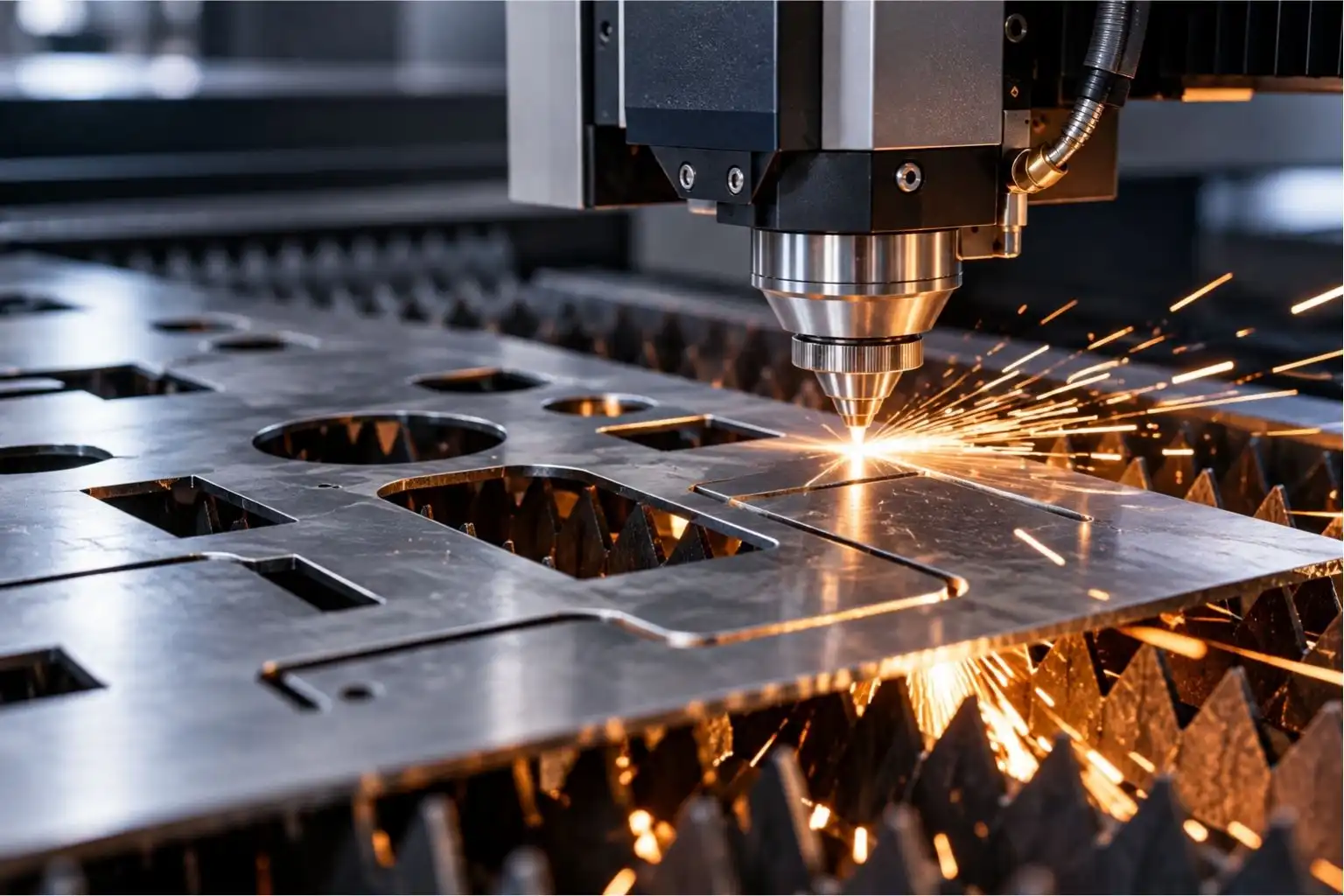
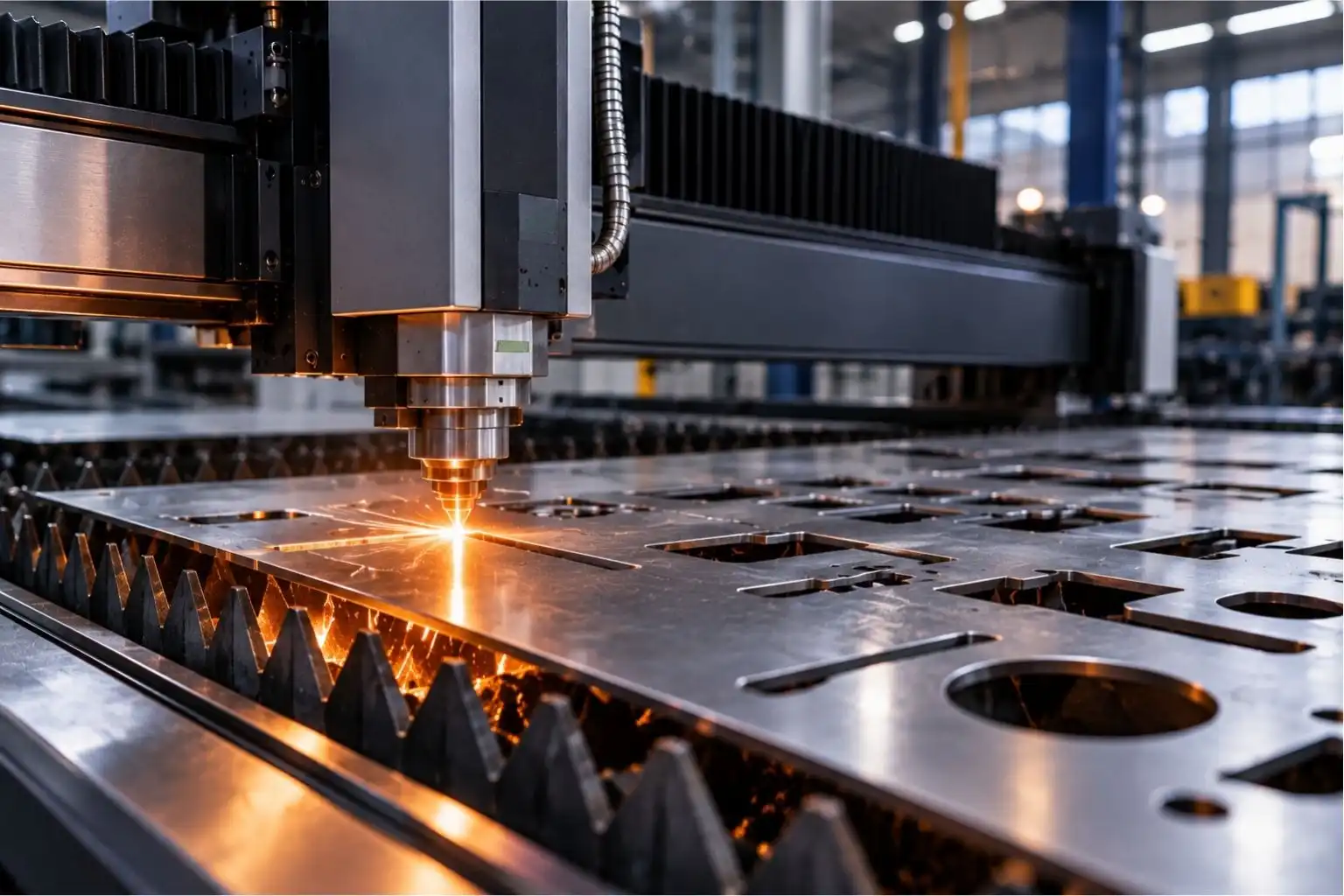
Laser profiling is the UK term for CNC laser cutting of sheet and plate metal. A focused laser beam melts metal along a path controlled by computer numerical control programming, so the cut follows the CAD geometry accurately from start to finish. Because the beam never touches the workpiece, nothing wears, bends or drags the sheet out of position, which reduces tool wear and makes complex shapes easier to produce than with traditional methods. The process runs in five stages:
- Programming: The part is drawn in CAD, then the data passes into CAD/CAM software for programming and nesting across the sheet, where the cutting path is set.
- Beam generation: A fibre or CO2 source produces a high-energy laser beam.
- Focusing. Optics in the cutting head concentrate the beam onto a spot a fraction of a millimetre wide.
- Cutting: The focused laser beam creates the cut as the head follows the programmed path.
- Clearing the kerf: A high-pressure gas jet, usually nitrogen or oxygen, removes molten metal from the kerf, clears residue from the cut line and shapes the edge finish.
For precision metal fabricators, manufacturers, engineers and buyers comparing plasma, waterjet, punching or other cutting methods, the value is straightforward: tighter tolerances, clean edges, faster output, repeatable parts and less waste without tooling costs.
Every error at the metal cutting stage travels downstream, turning rough edges into grinding time and distorted panels into fitting problems on site, so this guide explains what laser profiling is, how each stage works and the key advantages that improve accuracy, flexibility, material use and overall production cost.
8 Ways Laser Profiling Improves Precision Metal Cutting
Below are the eight advantages, with the detail that turns each into a reason to specify a laser for your next part:
1. Tolerances Tight Enough for First-Time Fit
Modern fibre laser profiling machines commonly hold around ±0.1 mm on thin to medium sheet, widening to roughly ±0.2 to ±0.5 mm as plate thickness increases. On suitable work, laser cutting can achieve tolerances within 0.001 inch (0.025 mm). Machine positioning accuracy can be around 10 micrometers, though achievable part tolerance still depends on material, thickness and cut conditions.
The kerf is narrow too, typically 0.1 to 0.3 mm on thin sheet, so fine features and close-fitting parts come off the bed as drawn. This precise control matters on welded frames, bolted assemblies and hinged panels alike. Tab-and-slot brackets for a steel frame locate themselves before welding, with minimal play in each slot. That self-jigging fit shortens set-up in our Fabrication & Manufacturing workshop and removes the measuring and marking that manual layout demands. Parts that fit first time also cut rework on assembly.
2. Clean Edges That Skip the Grinder
Concentrating the energy into a small spot leaves a narrow heat-affected zone compared with plasma or oxy-fuel. That small heat-affected zone helps prevent material distortion. Assist gas shapes the finish too. Nitrogen gives a bright, oxide-free edge on stainless steel and aluminium ready for welding or coating, while oxygen on mild steel cuts faster but leaves a thin oxide layer. That control also supports intricate designs where edge quality matters.
Well-tuned settings leave little to no dross, helping deliver precise cuts, so deburring shrinks to a quick pass or disappears entirely. Fewer finishing steps shorten lead times and lower labour costs per part. On stainless food processing panels, that clean edge supports hygiene requirements and gives the welder a tidy joint. Mild steel parts headed for paint go straight to preparation.
3. Speed That Shortens the Drawing-to-Part Timeline
Fibre lasers are widely reported to cut thin sheet under roughly 5 mm around two to three times faster than equivalent CO2 lasers. Load and unload towers and pallet changers let a laser cutting machine keep running between shifts with minimal operator supervision overnight, and CNC laser cutting machines can operate 24 hours a day for rapid lead times.
A batch of 500 small mounting plates, nested and cut in a single run, finishes in one shift. On suitable work, laser cutting can be up to thirty times faster than sawing. Cut and drilled by hand, the same plates could tie up a fitter for several working days. Quicker cycle times mean shorter turnaround from approved drawing to finished, packed part. For higher-volume runs, our General Manufacturing schedules the cutting alongside assembly and finishing for consistent lead times and fast turnaround.
4. One Process Across Many Sheet Metal Types and Thicknesses
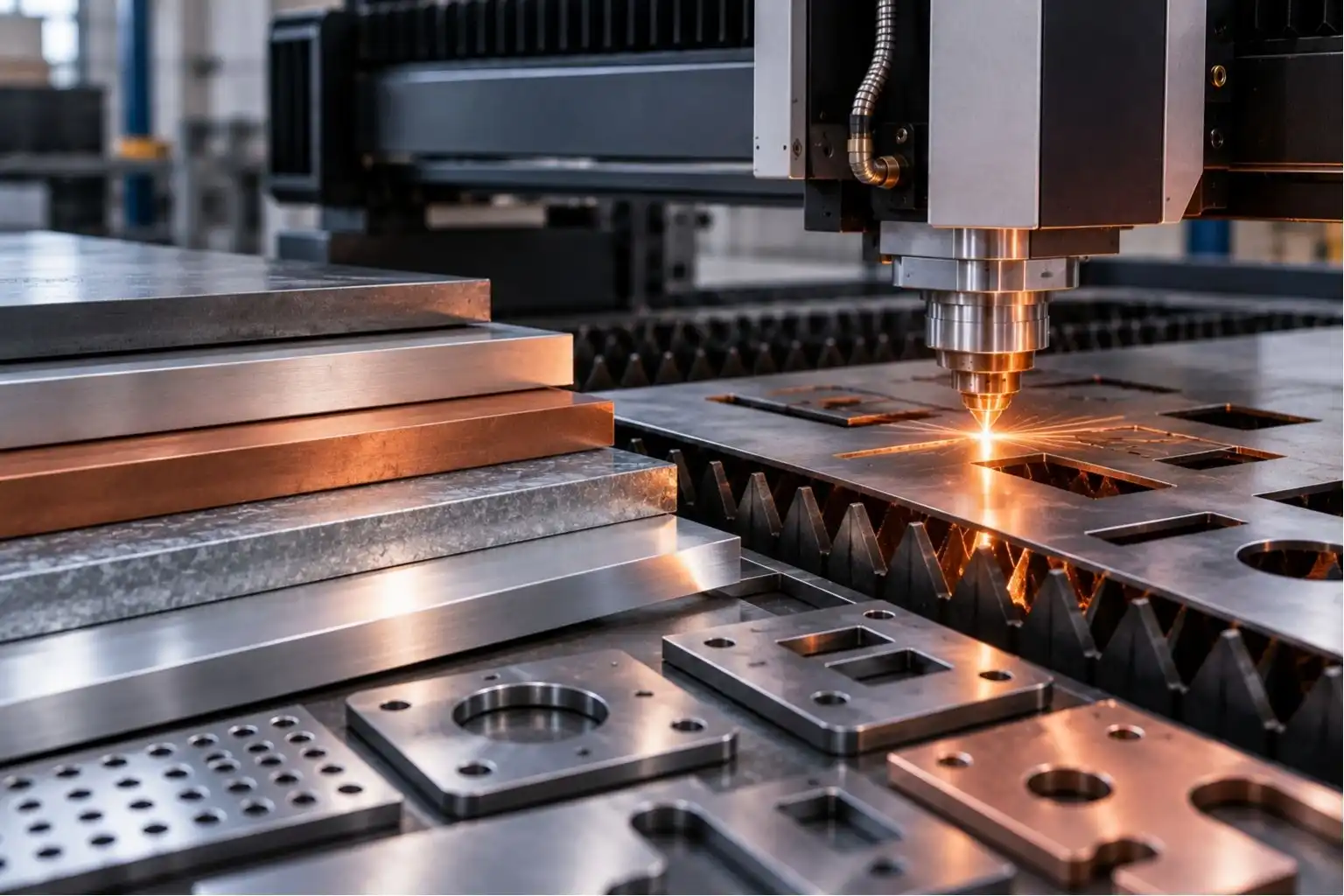
Fabrication jobs rarely use a single metal, and switching processes between grades adds handling time and cost. One machine covers a wide share of sheet and plate work, with the exact scope depending first on material type, including:
- Mild steel, galvanised steel, and carbon steel
- Stainless steel
- Aluminium
- Brass and copper, which fibre handles far better than older CO2 systems
This makes laser profiling effective across both ferrous and non-ferrous metals. Fibre machines rated at 6 to 12 kW typically cut mild steel up to around 25 to 30 mm, and ultra-high-power systems push past 50 mm. Some laser cutting machines can handle materials up to 50 mm thick, depending on power and the material being cut.
Stainless and aluminium capacity sits lower at the same power, so confirm limits per material. A guard combining aluminium covers, stainless panels and mild steel plates can run on one bed. Beyond metals, some laser cutting processes also cut sheet metal, plastics, wood, thermoset materials, and composites, with vaporisation cutting used for nonmelting materials like wood.
5. Design Freedom Without Hard Tooling
Punching and stamping rely on dies, and every new shape means new tooling cost. Metal laser cutting needs none, so intricate curves, internal cut-outs, intricate shapes and decorative patterns carry no set-up charge. Parts are programmed from DXF or DWG files, so a design change means a revised file and a same-day cut. Laser profiling is also effective for cutting decorative metal screens in architecture.
A useful design rule is that the smallest reliable hole diameter usually sits around the material thickness, so a 3 mm hole in 3 mm plate. Detailed architectural screens with intricate designs that would be slow to punch become routine work. If you hold no drawing for a worn component, our Mechanical Engineering can measure the original and produce one.
6. Nesting That Keeps Scrap Low
CAM software arranges parts tightly across each sheet, and common-line cutting lets neighbouring parts share a single cut, saving both material and cutting time. The narrow kerf also turns less material into waste per cut compared with plasma or oxy-fuel, which matters on expensive grades such as stainless steel. Its high precision and narrow kerf width also reduce material waste.
Small gussets and washers can be nested into the gaps between larger base plates, making this a highly efficient use of each sheet and turning would-be offcuts into usable components. Lower scrap cuts material cost per part, and the remaining sheet skeletons go for metal recycling. Offcuts large enough to reuse can be held back for smaller brackets, spacers or test pieces on the next production job.
7. Identical Parts From Prototype to Repeat Order
Once a programme is proven, every part in a batch follows the same path, so part one and part 1,000 match. No cutting tool touches the metal, so no tool wear drifts dimensions over a long run, and low clamping forces keep thin sheet flat throughout the cut.
A prototype enclosure signed off by a client can be re-ordered in batches of 200 months later with identical dimensions. The same file carries straight from sample to production on any of our sheet metal laser profiling machines. If those enclosures house control gear, our Electrical Support engineers can wire and fit them out once cut and formed.
8. Lower Running and Downstream Costs
Fibre systems have no mirrors in the beam path and no resonator gases, which reduces service time and consumable spend. With no dies to make, short runs and one-offs stay economical, and small batch orders avoid the tooling charges that punching or stamping would add. Lower energy draw per part adds a further saving on every shift. Typical laser cutting efficiency varies, with CO2 lasers around 5-10% and fiber lasers around 20-30%.
Accurate parts need less fitting, clean edges need less finishing, and precision cutting helps keep those downstream costs low; a broken machine can have a replacement part profiled from a drawing the same week. Where a Maintenance & Inspection survey flags a worn guard, bracket or spacer, a profiled replacement keeps the line running while longer-term repairs are planned.
Get the Cut Right Before the Part Reaches Assembly
Now that you know the eight advantages that separate a laser from older metal cutting methods, match them against your next drawing. Note the material grade, thickness, tolerance and quantity for each part, and flag any edge finish requirement. That brief lets a profiler quote accurately from the start.
Singleton Engineering profiles sheet and plate for producers across the UK, with parts cut to close tolerances and clean edges ready for welding or coating. Our Laser Profiling service handles mild steel, stainless and aluminium from a single DXF or DWG file, carrying one-off prototypes straight into repeat batch production. Contact us at office@singletonengineering.co.uk or 01282 423198 to get your next drawing profiled to tolerance.
Frequently Asked Questions About Laser Profiling
How will I receive finished parts from your laser cutting service?
We agree collection or delivery at the order stage, with parts packed to protect edges and finished surfaces in transit, and our efficient production helps support competitive pricing with rapid lead times, including 24-hour manufacturing where required. Larger orders can be split into staged deliveries to match your assembly schedule, so parts arrive as your line needs them and fast turnaround can support urgent projects and repeat schedules. Share your site access details and any delivery booking requirements at enquiry, and we will confirm dates before cutting begins.
Can you cut parts from a hand sketch if I have no CAD file?
Yes. A dimensioned hand sketch, a marked-up photograph or an old paper drawing gives us enough to start. We redraw the part in CAD, then send the file back for your approval before any metal is cut. Include overall sizes, hole positions, material grade and thickness on the sketch. Once you sign off the drawing, we keep it on file, so repeat orders go straight to cutting without redrawing.
Can you source the metal for my laser cutting machine job?
Yes. We can source mild steel, stainless steel and aluminium to the grade and thickness on your drawing, so the material arrives with the order. If you already hold stock, you can free-issue it to us and we will cut it on our laser profiling machines. Tell us at enquiry if the job needs material certificates or a specific finish such as brushed stainless, so we can confirm availability before quoting.
Can you help optimise my design to reduce laser cutting costs?
Yes. Before quoting, we can review your drawing and suggest changes that cut the price without affecting how the part performs. Common savings come from standardising material thicknesses across an assembly, reducing the number of internal cut-outs, and relaxing tolerances on non-critical edges. Small tweaks to corner shapes or part outlines can also improve nesting on the sheet. Ask for a design review at enquiry, and we will mark up suggested changes for your approval.