
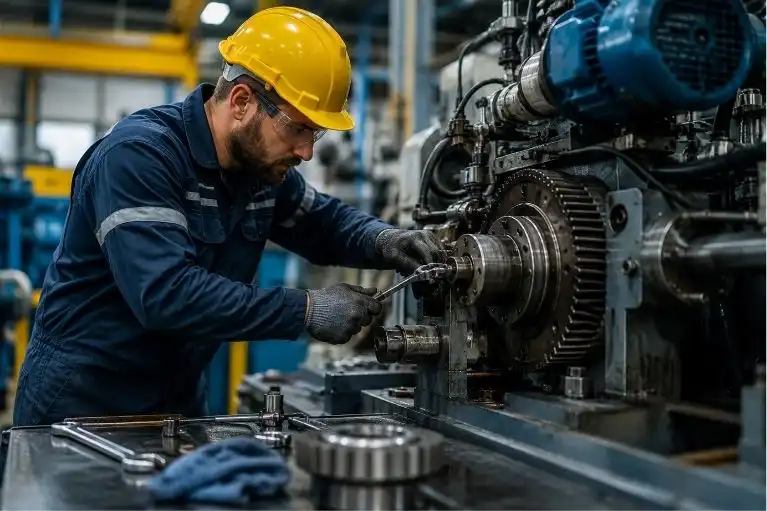
A single failed motor or worn conveyor bearing can bring an entire production line to a standstill within minutes, turning routine machinery maintenance, the ongoing work of inspecting, servicing, and repairing equipment so it runs safely and reliably, into an urgent, costly scramble. Unplanned downtime now costs Fortune Global 500 manufacturers close to $1.5 trillion a year, roughly 11% of total turnover, according to Siemens’ True Cost of Downtime report.
For operations managers, maintenance teams, and businesses in food production, packaging, distribution, water treatment, and similar sectors, that makes a practical maintenance programme central to protecting output, compliance, and contracts.
The following sections explain what effective machinery maintenance looks like, how preventive and reactive approaches compare, which preventative maintenance strategies reduce downtime, why plans need tailoring to different sites and industries, and where professional industrial maintenance services fit in.
What Is Machinery Maintenance
Put simply, machinery maintenance is the ongoing work of inspecting, servicing, and repairing equipment so it performs safely and reliably. Manufacturers asking what is machinery maintenance in practice find the answer comes down to one thing: consistency, since it covers more than moving parts: machine tool maintenance on CNC and laser profiling equipment falls under the same umbrella.
This is where industrial maintenance becomes a strategic function, not a background task. A site treating industrial maintenance as purely reactive pays more than one that plans well ahead. Sound plant maintenance is not overhead; it pays for itself, and water treatment sites depend on rigorous plant maintenance to avoid compliance failures.
How To Reduce Downtime Through Better Machinery Maintenance

Reducing downtime rarely comes down to one fix. It is the result of a repeatable process that most well-run sites follow in some form:
1. Audit Your Equipment First
Before building a machinery maintenance schedule, list every critical asset, its age, its failure history, and how disruptive its downtime would be to determine the right maintenance strategy for each asset based on criticality, downtime impact, and available resources.
This groundwork is the foundation of any credible plant maintenance plan and keeps later decisions grounded in real data, while a machine maintenance plan should also consider other factors beyond asset age and failure history.
2. Set A Preventive Maintenance Calendar
Move away from reactive repairs and instead use routine maintenance and regular maintenance through regularly scheduled service based on manufacturer guidance and real usage data rather than guesswork, since preventive care can be time-based or usage-based.
A calendar built this way supports routine checks and regular inspections, keeps machinery running, improves efficiency, and helps productivity, while maintaining equipment at optimal levels also supports operational efficiency.
3. Train Operators To Spot Early Warning Signs
Unusual noise, vibration, or heat are often the first indicators that machine tool maintenance is overdue, and training frontline staff as part of day-to-day maintenance work is one of the basic maintenance tasks and best practices because it helps them detect potential issues and potential problems early.
Regular inspection routines combined with proper documentation make these warning signs even easier to catch. Spot warning signs before failure occurs, and give engineers a genuinely valuable head start on any necessary repair work.
4. Track Data And Set Clear Thresholds
Condition based maintenance uses vibration sensors, temperature logs, or manual checks to monitor a machine’s actual condition and flag developing faults before they cause a breakdown. Reviewing this data regularly helps track performance trends and supports predictive maintenance.
With machine learning refining thresholds over time; for example, airlines monitor engine performance before takeoff to catch faults early, and once those limits are identified, prescriptive systems can use AI to automate maintenance tasks.
5. Bring In Specialist Support For Complex Assets
For bespoke conveyor systems, CNC equipment, or electrical control panels, professional industrial maintenance services fill the gap between in-house capability and the expertise a repair genuinely needs, especially where safety or production continuity is truly on the line, as maintenance technicians use diagnostic software and handheld computers to diagnose faults on complex assets.
Depending on the job, millwrights may also install, assemble, or move heavy mechanical assets within tight facility spaces. Following international safety standards also supports reliable, long-term maintenance operations.
6. Review And Adjust The Plan Regularly
No machinery maintenance schedule should stay static; update it as equipment ages, staff change, or production demands shift, and keep detailed records of all maintenance activities so you can develop better practices and preventive measures over time, use review cycles to extend asset life and improve the maintenance process, and improve maintainability by choosing replacement equipment that is easier to repair in harsh environments.
Singleton Engineering’s mechanical engineering and electrical support teams routinely work through this exact sequence with clients across food production, packaging, and distribution, tailoring the plan to each site’s equipment mix.
Preventive Vs Reactive Maintenance: What To Watch For
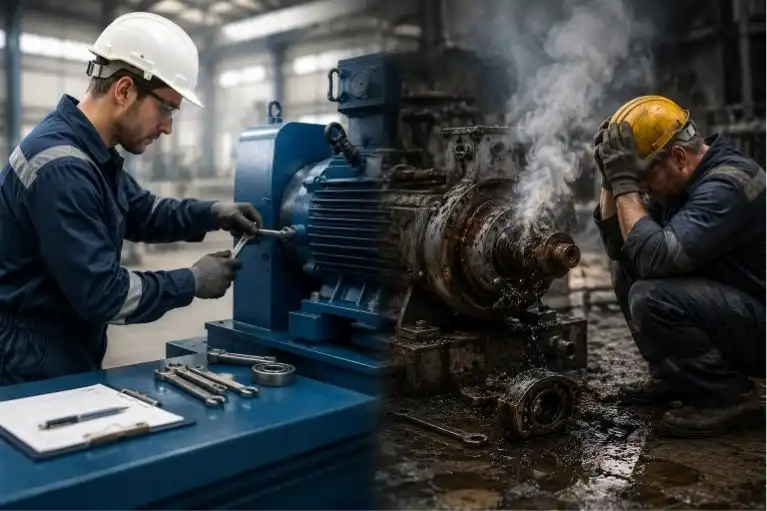
Not all maintenance approaches deliver the same result, and the difference shows up quickly on the balance sheet.
- Reactive repairs and corrective maintenance of machinery happen after a breakdown, when the line is already stopped and costs are highest.
- Preventive machine maintenance follows a fixed schedule regardless of condition, catching most faults before failure.
- Predictive industrial maintenance uses data and condition monitoring to time interventions precisely, cutting both cost and unnecessary parts replacement; by contrast, corrective maintenance is often more expensive because it follows unexpected breakdowns.
- Outsourced industrial maintenance services bring in specialist labour and equipment for jobs beyond an in-house team’s scope, such as laser and CNC profiling or structural steelwork repairs.
| Approach | Typical Trigger | Downtime Risk |
| Reactive repairs and corrective maintenance of machinery | Equipment has already failed | High |
| Preventive machine maintenance | Scheduled interval | Medium |
| Predictive plant maintenance | Sensor or data threshold | Low |
| Specialist industrial maintenance services | Complex or planned project work | Low |
The right mix depends on how critical each asset is and how much unplanned downtime the business can genuinely absorb, and poor choices here can lead to higher maintenance costs. Most sites end up blending all four approaches across different equipment. Scheduled machine tool maintenance on CNC and laser profiling equipment deserves particular attention here, since tight tolerances drift long before a machine visibly fails.
Which Businesses Benefit Most From A Structured Maintenance Plan
A single unplanned stoppage can cascade into missed orders, hygiene risk, or compliance failure, so some businesses in manufacturing environments running industrial machinery have more to gain from a structured maintenance plan than others:
- Food processing & Production: running continuous packaging lines, where a stainless steel, food-safe conveyor upgrade as part of a planned machinery maintenance overhaul can avoid a multi-day production halt during peak order periods.
- Distribution centres: relying on conveyor networks, where machine tool maintenance records and condition data make planned intervention far cheaper than an emergency callout.
- Water treatment sites: running critical pumping equipment, where ongoing machine maintenance keeps compliance obligations firmly on track.
- Manufacturers with ageing equipment or tight production schedules: these tend to benefit most from professional industrial maintenance services, since the cost of getting it wrong is measured in lost contracts as much as lost hours.
- Sites relying on production machinery and team-wide ownership: these often see the biggest gains from structured routines, and Total Productive Maintenance encourages shared responsibility for maintenance.
- Any site still asking what is machinery maintenance is worth to their bottom line: this same logic underpins industrial maintenance across every sector Singleton serves, not just food production, and the Siemens downtime figures answer that question clearly.
Whatever the sector, the pattern repeats: businesses that plan ahead spend less, lose less, and keep production moving, while those that wait for a failure end up paying for it in far more than just repair costs, especially when the right approach reflects the role of essential spare parts in reducing delays.
Keep Your Production Line Moving
The single most useful step any operations manager can take this quarter is to list every asset where unplanned downtime would be most damaging, and schedule its next machinery maintenance check before a fault forces the issue. Preventive maintenance helps keep machinery running, reduce unexpected breakdowns, and support a more reliable maintenance process, with routine inspections and routine checks an essential part of regularly scheduled service.
That one action, done consistently, prevents more lost production than almost any other single change to a maintenance plan, and it turns repairs and maintenance of machinery from a crisis response into routine business as usual.
If ageing equipment or unplanned stoppages are becoming a recurring problem, speak to our engineers about a tailored maintenance and inspection plan. Singleton Engineering Solutions has supported UK manufacturers and food producers since 2015, providing planned and reactive maintenance and inspection, and breakdown support alongside fabrication, mechanical engineering, and electrical support. Contact us at office@singletonengineering.co.uk or call 01282 423198 to get a quote.
Frequently Asked Questions About Machinery Maintenance
How much does a machinery maintenance plan cost?
Costs for a machinery maintenance plan vary depending on the size of the site, the number of assets involved, how frequently servicing is required, the scope of maintenance work, and the available resources, especially when planning for spare parts, so there is no single fixed rate that applies across every business.
Singleton Engineering assesses each site individually before quoting, taking into account equipment age, criticality, and existing maintenance history. Getting an accurate figure starts with a site conversation rather than a generic price list, since a tailored plant maintenance schedule genuinely reflects what your equipment needs, not a standard package.
How quickly can Singleton Engineering respond to a breakdown?
Response times depend on the nature of the fault, the equipment involved, and whether a client already has a maintenance and inspection agreement in place with Singleton Engineering. Sites with a standing contract typically receive faster prioritisation than one-off callouts, since engineers already understand the equipment and its history.
For urgent breakdowns affecting production, the team works to get a qualified engineer on site as quickly as possible, minimising unplanned downtime and its knock-on costs. Businesses that rely heavily on continuous production, such as food processing or packaging lines, are encouraged to discuss response expectations upfront so any machine maintenance emergency is handled with minimal delay and disruption to output.
Do you offer ongoing industrial maintenance services contracts?
Yes, Singleton Engineering provides ongoing industrial maintenance services structured around each client’s equipment, sector, and operational demands, rather than a one-size-fits-all package. These arrangements typically combine scheduled inspections, preventive servicing, and rapid access to reactive support when something goes wrong unexpectedly, helping develop a more reliable maintenance strategy and support ongoing maintenance operations.
A structured contract gives operations and maintenance managers predictable costs and clearer visibility over upcoming work, instead of relying on ad hoc repairs whenever a fault appears. This approach suits food producers, packaging lines, and distribution sites where downtime carries a real commercial cost. Discussing your equipment list and current maintenance approach with the team is the best place to start.
Which areas does Singleton Engineering cover for maintenance and inspection?
Singleton Engineering is based in Burnley, Lancashire, and provides maintenance and inspection support to manufacturers and food producers across the UK, not just the immediate local area. The team regularly works with clients in food production, packaging, water treatment, and distribution, travelling nationwide for both planned servicing and reactive breakdown support.
Being based centrally in the North West allows efficient coverage across much of the country, while established client relationships mean repeat visits are handled by engineers already familiar with the equipment involved. Businesses outside the immediate region are encouraged to get in touch directly to confirm coverage and discuss how a tailored maintenance plan could work for their site.