


A production line rarely fails in one dramatic moment. It slows, it stops more often, it scraps a few more units each week, and by the time replacement looks obvious the money has already drained away through downtime, energy and rework. The awkward part is that ageing plant keeps producing right up until the week it does not.
According to Deloitte’s Analytics Institute, poor maintenance strategies can reduce a facility’s overall productive capacity by 5 to 20%, while predictive maintenance approaches have been shown to increase equipment uptime by up to 20% and cut breakdowns by 70%. So which warning signs actually justify capital spend, and how do you tell a machine that needs a service from one that needs replacing?
Why Ageing Industrial Machines Cost You Before They Break
Older manufacturing equipment carries costs that never appear on a repair invoice across the wider manufacturing industry. Energy draw creeps up as motors and drives lose efficiency, scrap rates rise quietly as tolerances drift, and operators build workarounds into the shift routine until nobody notices them any more. On food manufacturing equipment, hygiene downgrades join that list for this part of the industry.
That’s why machinery replacement decisions rarely rest on breakdown history alone. Food production lines carry extra traceability and cleanability exposure, since stainless steelty, typically grades 304 and 316, is preferred for its non-porous, crevice-free surfaces that resist bacteria traps; as those surfaces, seals and washdown tolerances degrade, product quality suffers even before output does. Building the case while the asset still runs gives you time to specify properly, instead of buying under pressure at three in the morning.
The Global Industrial Machinery Market was USD 592.4 Billion, and manufacturing equipment has undergone a massive transformation through digital integration and smart automation, widening the gap between older and newer industrial machinery.
10 Signs It’s Time to Upgrade Your Manufacturing Equipment

Below are the ten signals worth tracking, with the evidence that turns each into an argument a finance director will accept:
1. Unplanned Downtime Is Climbing
Trend matters more than the raw number. A machine that stopped twice a quarter and now stops twice a month is telling you something, no matter how modest the total hours look. Track mean time between failures across consecutive quarters, and watch the availability component of your OEE figure while performance and quality hold.
Put a cost against it before taking the case upstairs. Hourly cost equals lost output multiplied by contribution per unit, plus idle labour and any expedite charge. A scheduled servicing record gives you the log to prove that trend rather than argue it from memory, which matters because production machinery rarely gets replaced on a hunch.
2. Maintenance Spend Is Closing In on Replacement Value
Plenty of operations run a rule of thumb: once annual maintenance passes a set share of replacement value, the asset goes under review. Treat that as a decision framework rather than a single fixed percentage, since the right threshold shifts with asset life and utilisation.
Build a five year picture for the worst performing factory machinery in your fleet, tracking maintenance spend, downtime hours and spare parts lead times side by side. The crossover point is where keeping the manufacturing equipment costs more than replacing it. Watch the ratio of emergency to planned work orders too, since on older production machinery that shift usually arrives before the spend does.
3. Spare Parts Are Hard to Source or Support Has Ended
Once an OEM withdraws support, exposure stops being a maintenance question and becomes a continuity one. Parts arriving only from auction stock and third party refurbishers mean one failure can become a multi-week outage. Contrast two scenarios for one component, shipping next day against a six week wait, then cost both using your sign one figure.
Holding critical spares on dedicated industrial storage equipment buys breathing room, though it ties up capital and only covers parts still in production. Where a component is genuinely obsolete, bespoke Fabrication & Manufacturing reproduces it to the original specification, keeping food production machinery running while a replacement is scoped with food manufacturing equipment suppliers.
4. Energy Consumption Is Out of Step With Current Specification
Older motors, drives and compressors carry a running cost that never lands on a maintenance report, and newer units are often more cost-effective to run, not just lower in energy draw. With UK industrial energy prices where they are, this line often carries the payback case on its own, and it rarely shows up in a breakdown log.
Meter consumption per unit of output and compare it against a current equivalent. Check motor efficiency class, compressed air leak rates and idle draw when the machine is producing nothing. Ask food manufacturing equipment suppliers for metered figures rather than headline claims, then extend the per unit difference across annual volume to show reduced operating costs and a lower carbon footprint per unit produced when energy-efficient machinery replaces outdated systems. Properly specified Mechanical Engineering work also recovers part of that loss on industrial equipment worth keeping.
5. Scrap and Rework Rates Are Creeping Up
Quality drift is a wear signal that appears long before a breakdown does. Tooling wear, spindle runout, calibration drift and thermal instability show as tolerance creep first, with precision issues often appearing earliest in cutting operations, and on food manufacturing equipment the same drift surfaces as fill weight variance or seal failures. The cost stays quiet, sitting in material and labour, not a repair bill. Watch for:
- First pass yield trending down
- Control charts widening
- Recalibration happening more often than scheduled
- Rework hours per thousand units climbing
Cost a one percentage point rise in scrap against annual volume, including labour already invested. Where drift sits in cut accuracy, Laser Profiling uses a focused beam for precise cutting of metal parts, holding paper-thin lines that older production machinery struggles to maintain. By contrast, plasma handles conductive materials quickly, waterjet reaches material up to 12 inches thick, and oxy-fuel suits thick metal.
6. The Machine Has Become Your Bottleneck
A machine can run faultlessly and still be wrong for the business if demand has outgrown it, reframing the conversation from failure to opportunity cost, the argument that usually unlocks capital, especially where higher-throughput machines add capacity rather than just replace failing assets. Watch for cycle time drifting above takt time, WIP stacking up ahead of the station, weekend shifts clearing backlog, and orders declined outright.
Quantify the revenue turned away or the premium paid to subcontract overflow. For lines feeding Packaging & Distribution, one slow station paces everything behind it, so replacement equipment should be specified from takt time, especially where packaging machines automate packing, filling, sealing and labeling, improving speed, cost and consistency across food, pharma and consumer goods production.
7. Safety and Compliance Gaps Have Opened Up
PUWER 1998 requires work equipment to be suitable, properly maintained and fitted with adequate protective devices, and that duty applies no matter how old the asset is. LOLER 1998 covers lifting equipment. Older machines predate current guarding and interlock expectations, and age is not a defence. Review guarding, emergency stop category and response time, noise and vibration readings, and any insurer condition on file.
Consider if automation or robotics could improve worker safety by taking over hazardous tasks as part of safer compliance upgrades on older equipment. In Food Processing & Production, hygiene sits alongside machinery safety, so ageing food production machinery can fail an audit on cleanability while remaining mechanically sound. Compliance is the one area where manufacturing equipment gets replaced on obligation rather than payback, across industrial equipment of every type.
8. It Cannot Connect to Anything Else
An asset with no output beyond a local counter can’t feed production monitoring, planning or predictive maintenance, and as the plant becomes instrumented, that gap spreads to every report built on it. Check for standard industrial protocols, MES/ERP links, and IIoT connectivity for real-time data. Consider how much reporting still relies on a clipboard.
Automation software coordinates machines; AI improves decisions by analyzing that data live. Without condition monitoring, maintenance stays reactive or calendar-based, the expensive end of the scale. Retrofit sensors and a control panel rebuild through Electrical Support keep older equipment earning its place, while digital twins and closed-loop quality control cut defects before physical changes are made.
9. Only One or Two People Can Operate or Fix It
Legacy assets often run on undocumented knowledge held by long-serving staff, a risk that grows as more companies adopt robotics and faster assembly lines. When those people retire, the capability leaves with them, and training replacements on obsolete technology is both hard and unappealing to younger engineers.
Cobots and robotic arms now offer more consistent, better-documented alternatives for assembly and material handling. Map your skills matrix against each asset, and ask bluntly: if the one person who can coax that machine through a changeover is off sick, what happens to the delivery? On older equipment, manuals are often missing and OEM training no longer exists, and in food production, a halted line means product loss.
10. It Cannot Flex to New Work
Long changeovers, narrow tolerance capability and an inability to run new materials all limit what the business can quote for. This is the closing sign because it moves the argument from cost avoidance to growth, which is the version finance tends to hear.
Measure changeover and setup times, minimum viable batch size, and tolerance capability against what customers are actually asking for today. Manufacturers turning away short run or higher specification work often win it back after an upgrade. New materials bring fresh handling and industrial storage equipment needs too. In General Manufacturing, talks with food manufacturing equipment suppliers go better once you can state a tolerance and batch range.
When Keeping the Machine Is the Right Call
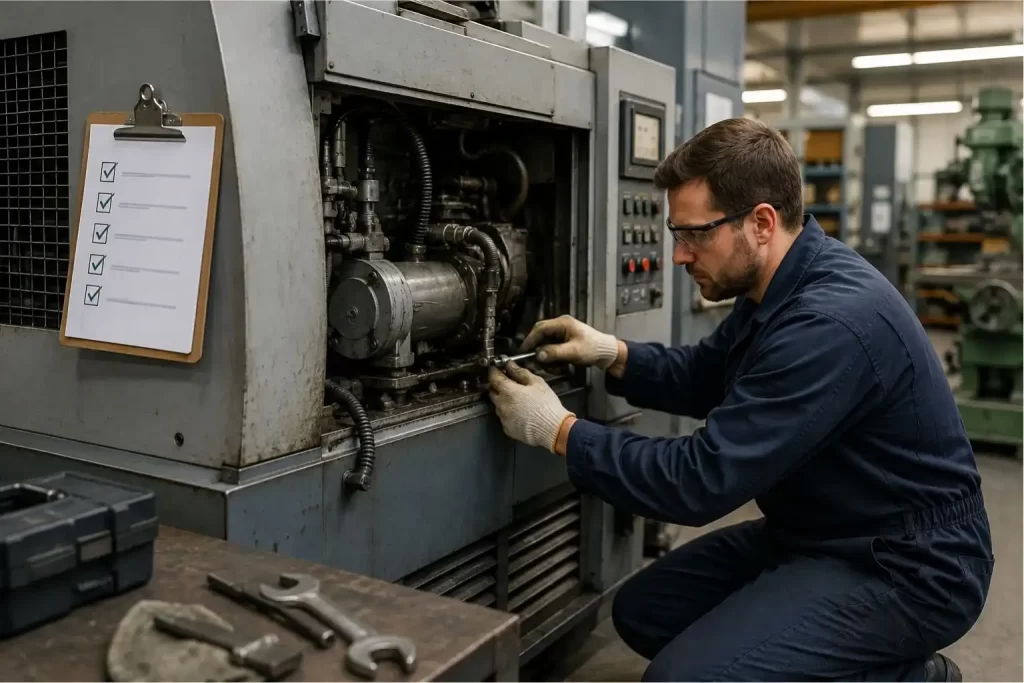
Not every ageing asset needs replacing. Check these four routes before committing to capital spend:
- Refurbishment. A sound frame with worn wear parts is often worth rebuilding, which is common on food manufacturing equipment where the stainless structure outlasts the drive train.
- Control system replacement. Old mechanics with new controls restore accuracy and add the connectivity from sign eight, while quality inspection equipment can detect defects earlier and support safer, more consistent output.
- Retrofit sensors. Condition monitoring on existing factory machinery costs a fraction of replacement and answers the data question.
- Better storage and handling. Reorganised industrial storage equipment around a station sometimes clears a bottleneck that looked like a machine problem, and material-handling equipment such as conveyor belts improves flow, reduces handling time between stages, and supports the right tools at each step.
If three or more of the ten signs apply, and at least one is compliance or obsolescence, replacement is usually the stronger case. One or two signs on their own generally point to a repair, though some assets are worth keeping where industrial mixers or centrifuges still perform their processes reliably.
Know Before the Machine Decides for You
Now that you know which ten signals separate a machine needing a service from one needing replacement, put numbers against the ones that apply. Track four figures monthly for your worst asset: maintenance spend, downtime hours, scrap, and metered energy. Three months of that record gives food manufacturing equipment suppliers something concrete to quote against.
Singleton Engineering designs, builds and maintains machinery for producers across the UK from our Burnley base. Our maintenance and inspection service surveys ageing lines and sets out what to keep, what to upgrade and what to replace. Get in touch at office@singletonengineering.co.uk or 01282 423198 before the machine sets your timetable.
Frequently Asked Questions About Manufacturing Equipment
How do I get a quote for upgrading manufacturing equipment?
We start with a site visit rather than a specification sent by email, since layout, utilities and tie-in points shape the price as much as the machine itself. Have three things ready for us: your downtime and maintenance log, any original drawings or panel schedules you hold, and the output figures the replacement must hit.
Photographs of the line and its access routes help us before we travel out. Flag any hygiene or audit requirement at this stage too, since it affects material choice. Our pre-quotation survey covers asset condition and access constraints in one visit, so the quote reflects your building and your line rather than a generic assumption.
How long does it take to install replacement production machinery?
Our lead times split into three stages: design and approval, fabrication, then installation and commissioning. Design moves fastest when you supply drawings and takt requirements upfront, while fabrication depends on material availability and build complexity. Installation itself is often the shortest stage, though we fit it around a planned shutdown rather than a convenient date.
Book that window early, since production machinery we install during an existing shutdown avoids a second stoppage. We give you a stage by stage programme at quotation rather than a single end date, so any slippage stays visible. Confirm with us who covers lifting, access equipment and disposal of the old asset.
What aftercare should come with new factory machinery?
Confirm this before ordering, since aftercare varies between suppliers far more than the machines do. We hand over the operating and maintenance manuals, a spares list with part numbers and a recommended service interval, and our maintenance team can be your named contact for breakdown support. Ask any supplier what happens once the warranty ends and how long spares will be supported, since that answer determines the working life of the asset.
Operator and engineer training should be scheduled at handover rather than offered later as an extra. Get these terms into the purchase order instead of relying on a verbal assurance, because it costs nothing and stops obsolescence repeating.
Does upgraded or modified machinery need new compliance documentation?
Modifying an existing machine can change its compliance position, so we treat this as a live question on every upgrade. Substantial modification may create duties around conformity assessment, and guarding, interlocks and emergency stop circuits usually need reassessing once a machine has been altered.
Your PUWER duties as employer continue regardless of what we or any other supplier provide. Ask us at quotation stage who produces the updated risk assessment, the revised technical file and any declaration, then get it named in the order. We work to current HSE guidance, and would rather confirm the position with you before the machine is ordered than after it is installed.